More Football in the Same Ninety Minutes: Effective Time After the New Rules
Introduction
After two editions spent on the transfer market, we return to the pitch. Three matchdays into the new season, one topic has come up more than any other in the conversation around Serie A: how much of a match is actually being played. Effective playing time has been a recurring grievance in Italian football for years, but this season it arrived with a specific trigger. A package of rule changes designed to cut time-wasting, first seen at the 2026 World Cup, is now in force in every European league, and the early impression in Italy is that matches feel faster and more open.
Impressions are a reasonable starting point. They are not a finding. In this edition we use our tracking data from the first three matchdays of 2026/27, compared with the same three matchdays of 2025/26, to answer three questions. Has effective time actually increased, and where? Which restarts are being executed faster? And in the league where the change is largest, is more playing time translating into more attacking output?
One caveat applies throughout: thirty matches per league is a small sample, and the figures below describe an early trend rather than a settled picture.
What changed, and where it applies
The changes come from IFAB, the body responsible for the Laws of the Game, and were approved at its Annual General Meeting in February 2026. They were applied at the World Cup ahead of their formal entry into force on 1 July, and they are mandatory in every competition from 2026/27. Three of them are relevant here.
The first extends the countdown principle to throw-ins and goal kicks. Where a referee judges that a restart is being deliberately delayed, a visible five-second countdown begins. If the ball is not in play when it ends, a throw-in passes to the opposing team and a delayed goal kick becomes a corner for the opposition. The countdown is discretionary and does not start at every restart, and long throw-in routines are treated as set pieces and exempt from it.
The second sets a ten-second limit for a substituted player to leave the field. If it is exceeded, the replacement cannot enter until the first stoppage after a full minute of play. The third requires any player who receives treatment on the pitch to remain off it for at least one minute.
Two points matter for reading the data. The eight-second limit on goalkeepers holding the ball was introduced a year earlier, so it is already in the 2025/26 baseline. And because the rules are identical across leagues, differences between them cannot be attributed to regulation. They reflect how strictly the rules are applied, how far each league had to travel, and how quickly players have adapted.
Effective time across the top five leagues
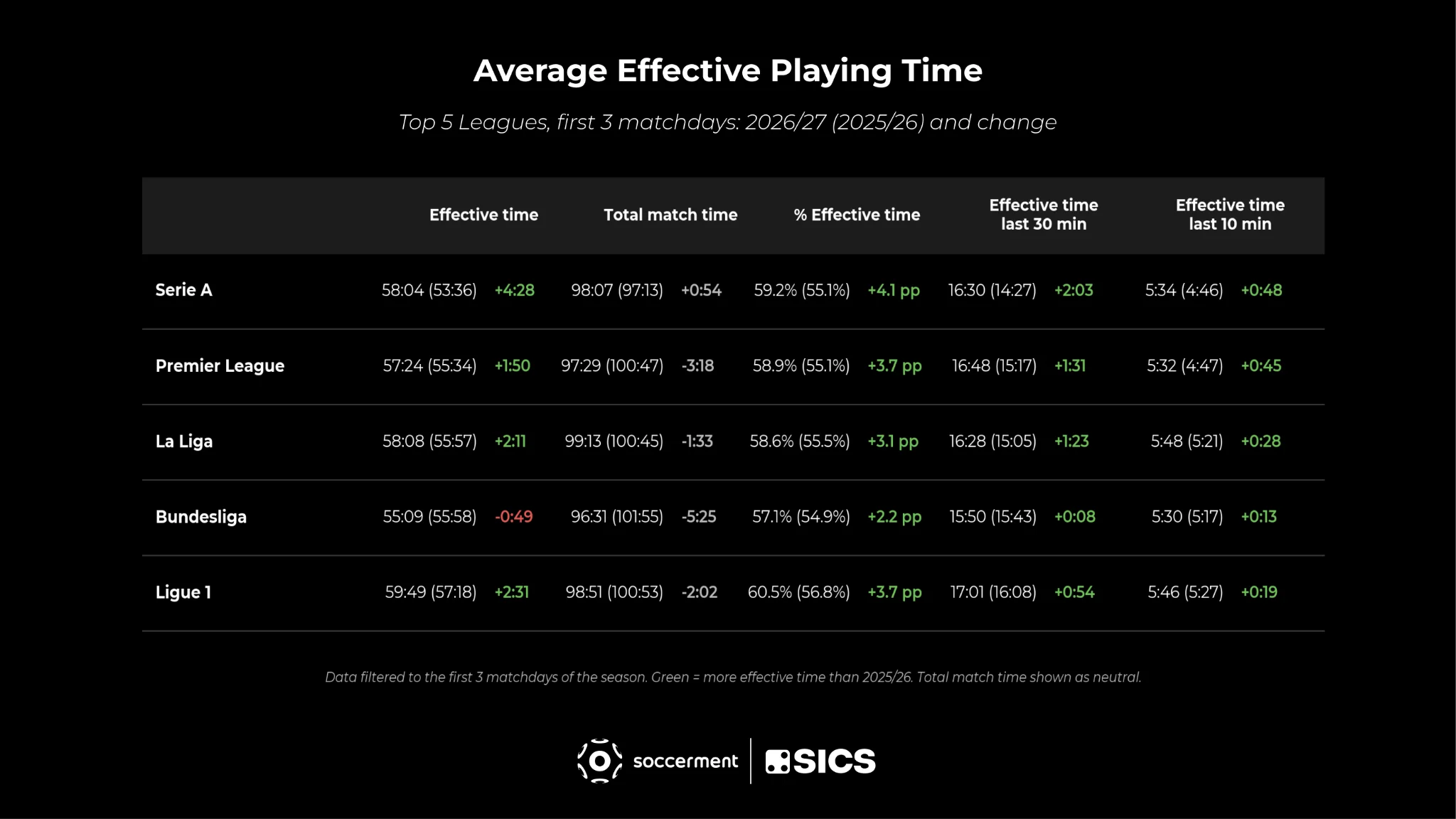
Four of the five leagues are playing more football per match than a year ago, and Serie A has gained the most by a wide margin: 4 minutes 28 seconds of effective time, from 53:36 to 58:04, against increases of between two and two and a half minutes in France, Spain and England. The Bundesliga is the exception, with effective time down 49 seconds.
The percentages hide a difference in mechanism. Outside Italy, total match time has fallen everywhere, by more than five minutes in Germany, so part of the improvement in the share of ball in play comes from shorter matches with less added time. Serie A is the only league where total match time has gone up. Its improvement is not a shorter match with the same amount of football in it, but more football inside a match of similar length.
The closing stages, historically the most exposed to time-wasting, follow the same pattern: Serie A has gained two minutes of effective time in the last 30 and 48 seconds in the last ten, more than any other league. It is worth noting where it started. In 2025/26 Serie A had the lowest effective time in the group on every measure. In 2026/27 it sits level with the Premier League and La Liga. The story so far is convergence rather than overtaking.
Where the time is coming from
To understand what is driving the change we measured the average time between the ball going out of play, or a foul being committed, and the ball being back in play, for each type of restart and split by the game state of the team taking it.
Throw-ins and goal kicks
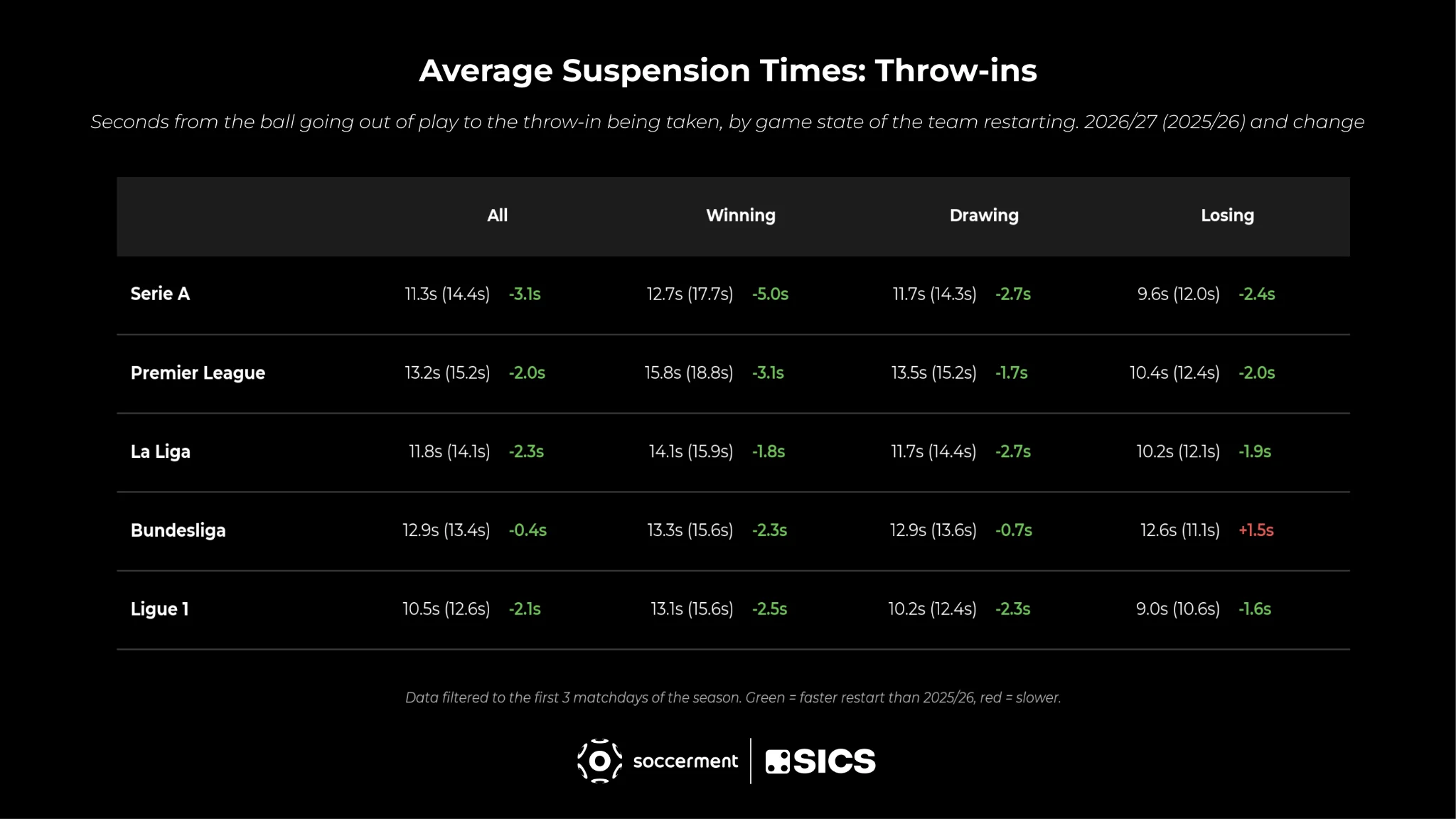
These are the two restarts directly covered by the new countdown, and they are where the change is most consistent. Throw-ins are quicker in all five leagues, and in Serie A the reduction is concentrated exactly where time-wasting lives: teams that are winning now take 12.7 seconds, down from 17.7 a year ago. The Bundesliga is again the outlier, with almost no overall change.
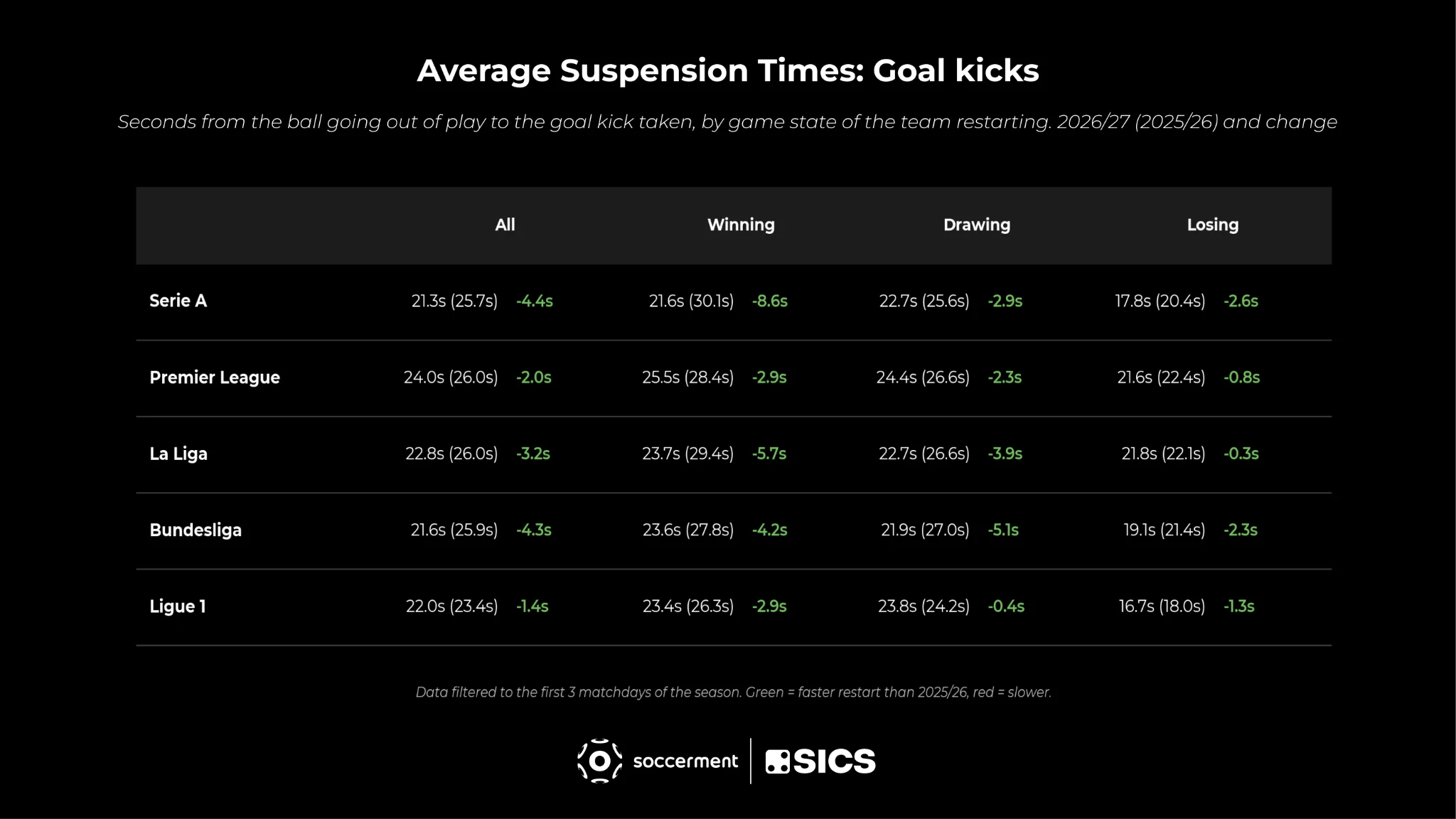
Goal kicks show the clearest effect of all: the average has fallen in every league and in every game state, including the Bundesliga. The Serie A figure for winning teams is the single largest movement in the entire dataset, from 30.1 to 21.6 seconds. The sanction here, a corner to the opposition, is the most severe in the package, and goalkeepers appear to have adjusted quickly.
Free kicks
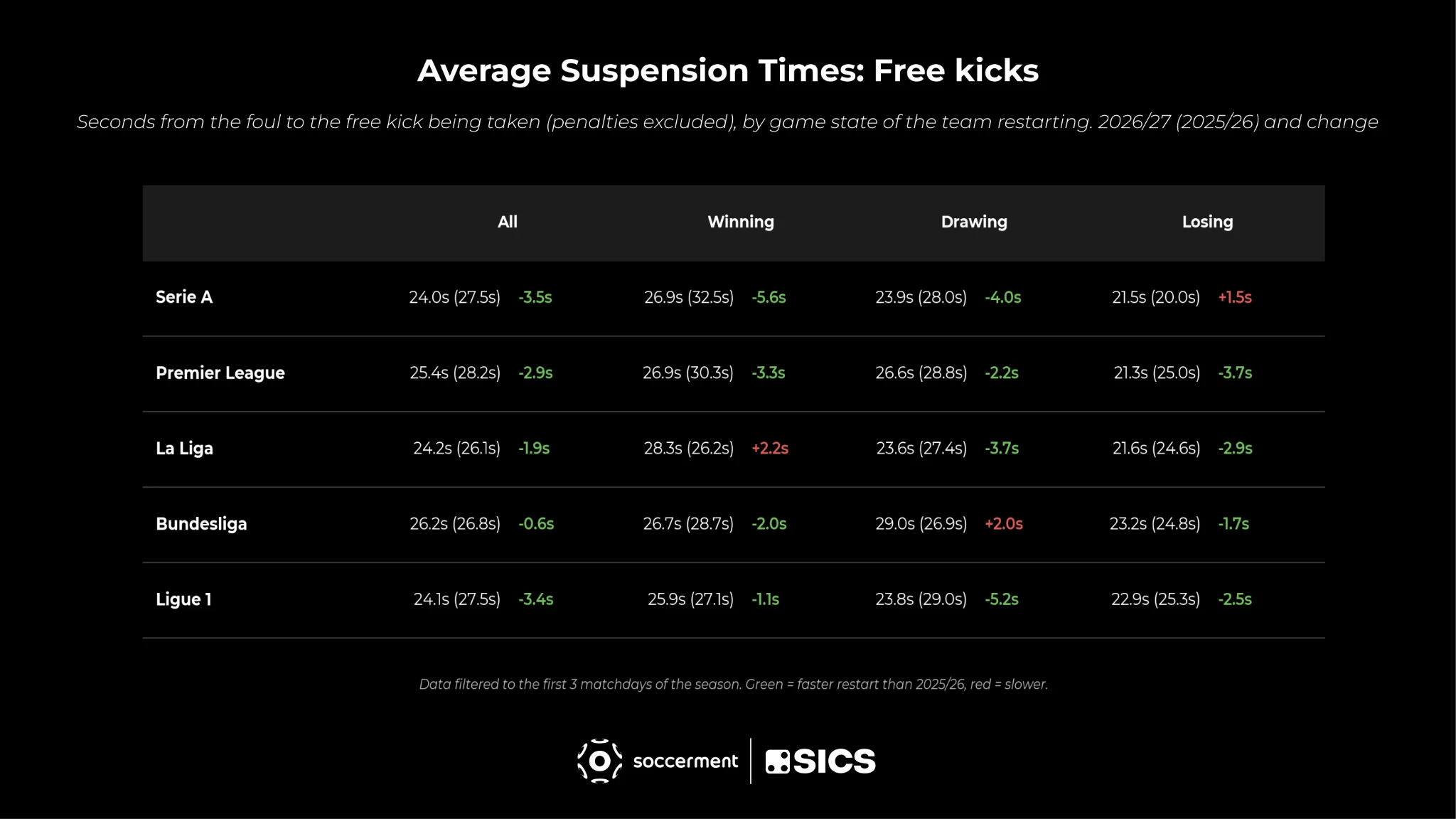
There is no new rule for free kicks, which makes this the most interesting table. Restart times have fallen anyway in four of the five leagues, and in Italy and England the reduction is again largest for winning teams. This looks like a spillover effect: referees have a mandate to protect playing time and appear to be applying it beyond the restarts the countdown formally covers, while players who know a delayed throw-in will cost them possession may simply be moving faster at every stoppage.
Corners
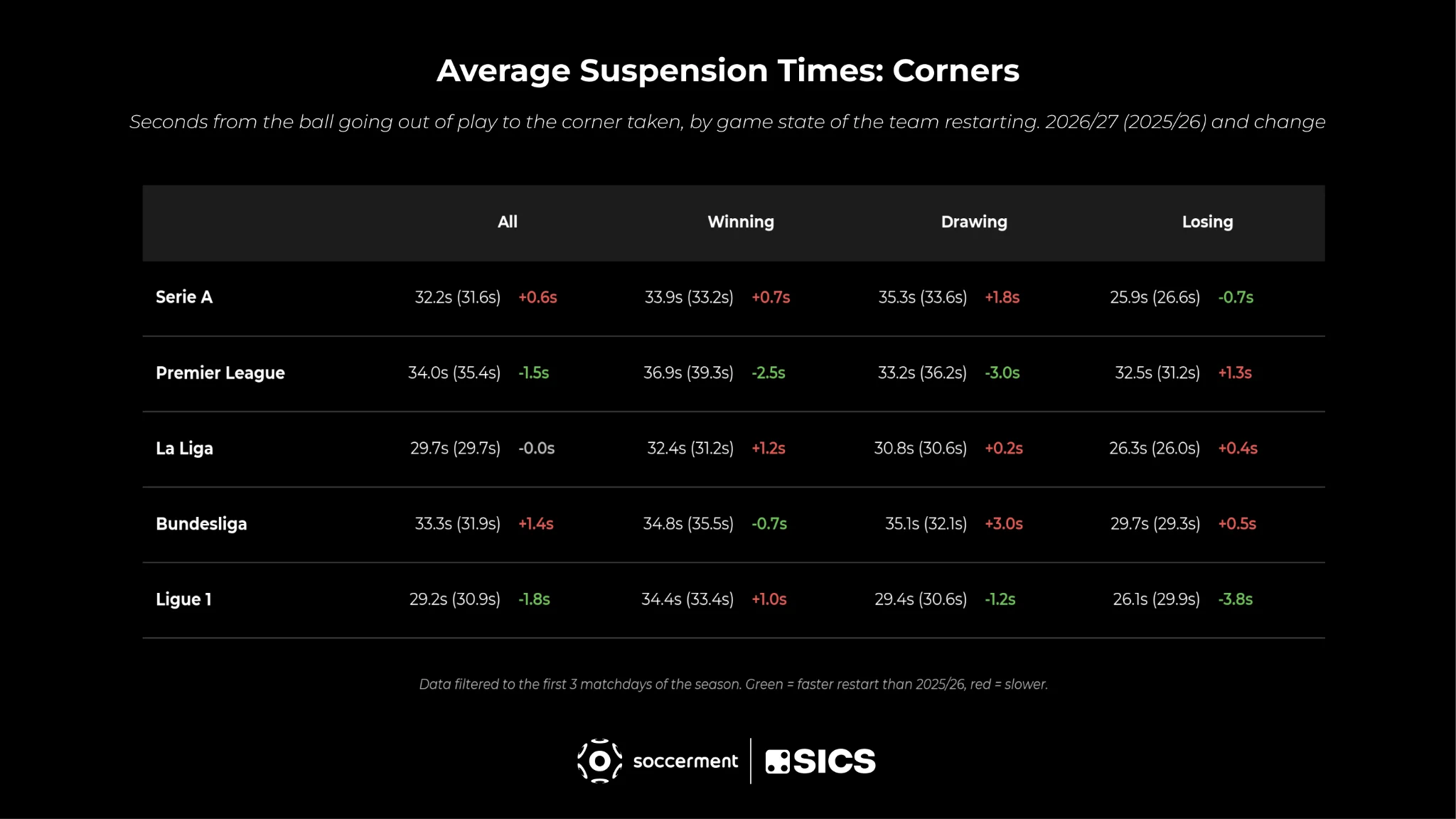
Corners are the exception, and a telling one. Restart times are flat or marginally up in three of the five leagues and down only slightly in the other two. This fits what we described earlier this season in our analysis of set pieces: the time spent before a corner is preparation, not stalling. The new rules are cutting the dead time that had no footballing purpose and leaving the time that does.
Serie A: more time, more shots, more goals
Serie A is the league where the change is largest on every measure, which makes it the natural place to ask the next question. If matches contain four and a half more minutes of football, what happens to attacking output?
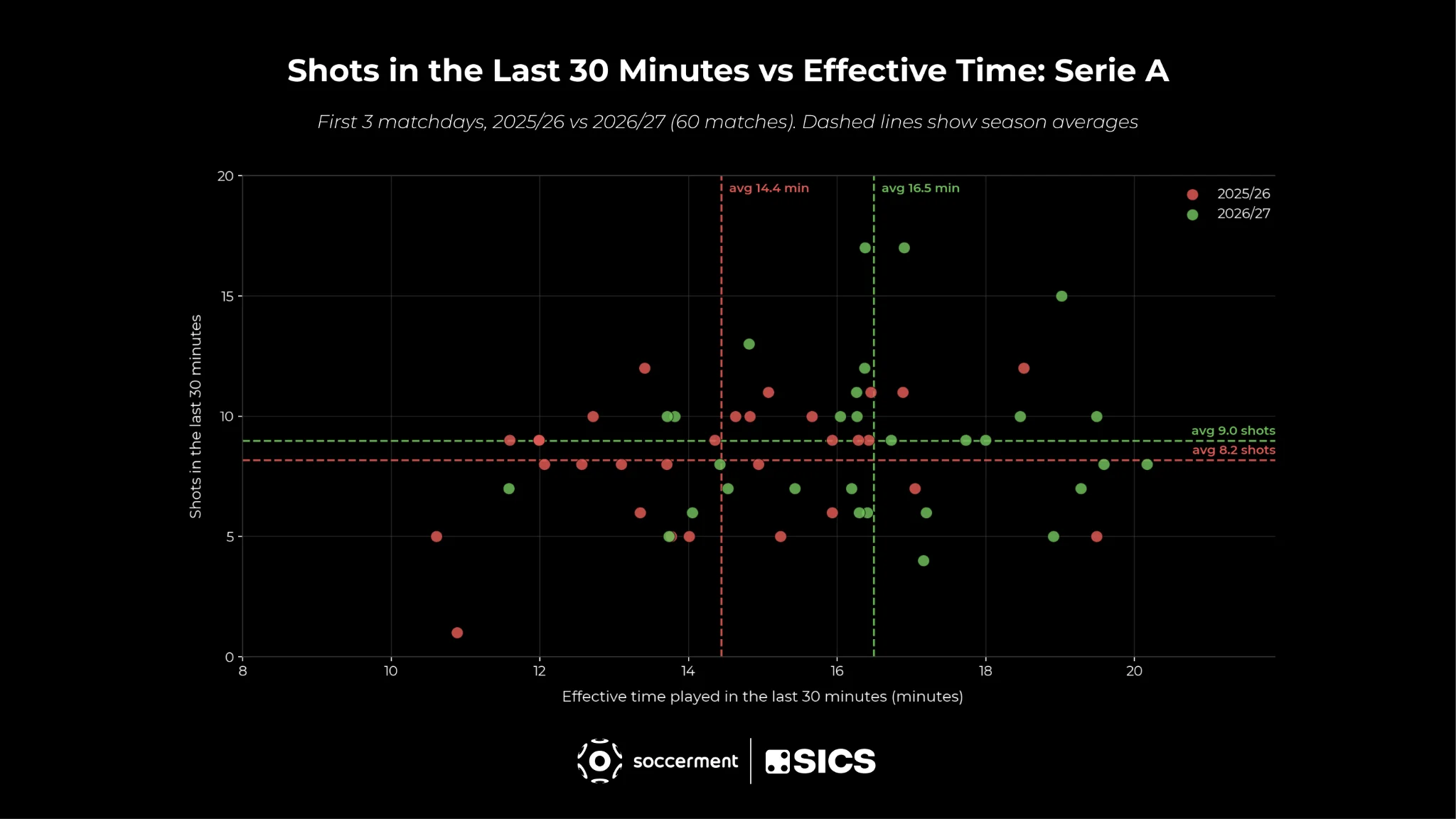
In the last 30 minutes, effective time has risen from 14.4 to 16.5 minutes per match and shots from 8.2 to 9.0. The distribution has shifted as much as the average: last season 13 of 30 matches produced fewer than 14 minutes of effective time in the closing half hour, this season 22 of 30 produce more than 15. The three highest shot counts in the sample all come from 2026/27.
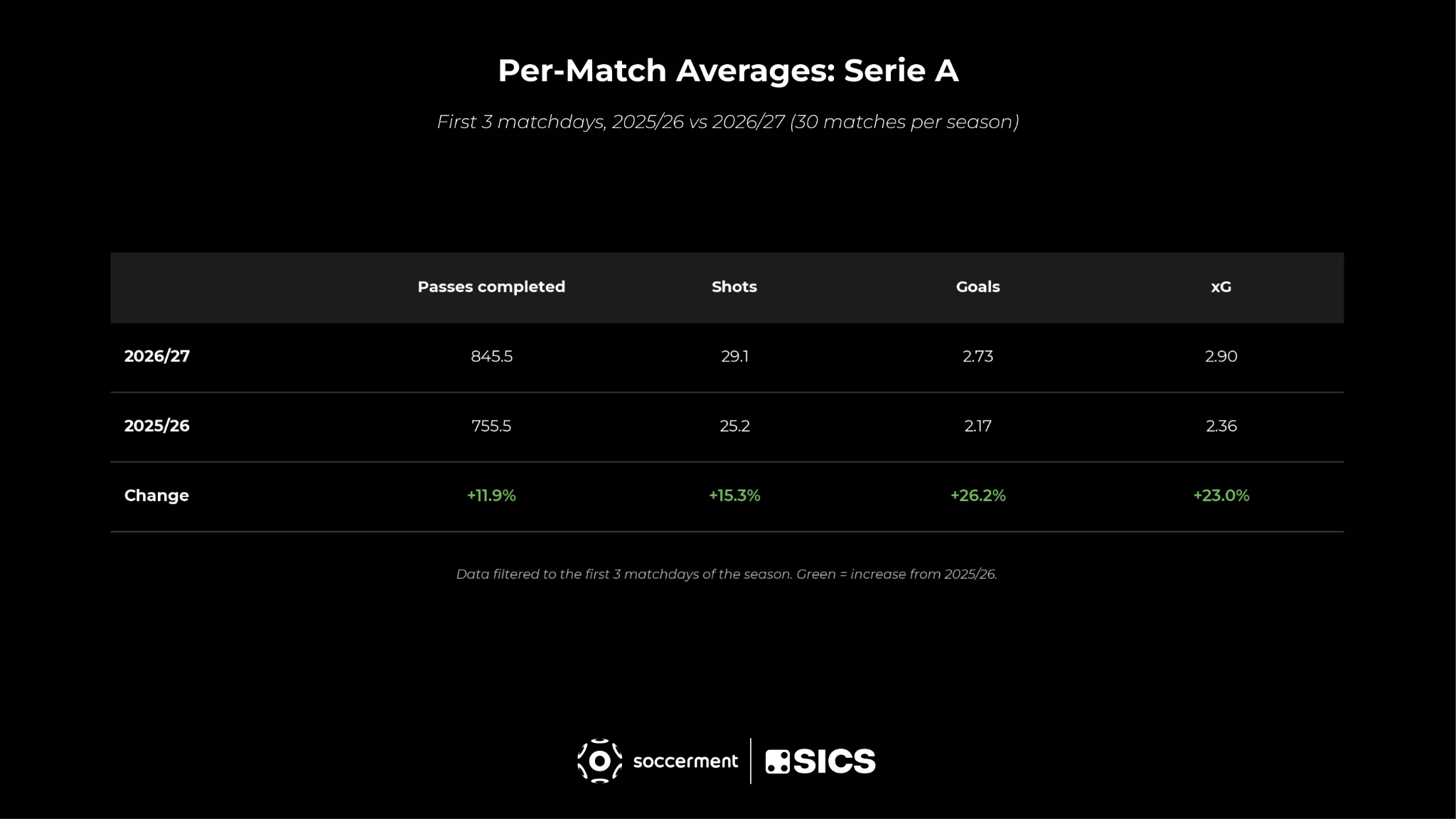
Over the full match, output has grown faster than time. Effective time is up 8.3%; shots are up 15.3% and goals 26.2%, from 2.17 to 2.73 per match. Some of that is arithmetic, since more minutes with the ball in play means more of everything. But the shot rate per minute of effective time has also risen, by around 6%, so matches are not only longer in football terms but slightly more intense within the time played.
Two qualifications are necessary. Goals have grown faster than expected goals (26.2% against 23.0%), and that gap is finishing variance that a larger sample would be expected to narrow. And the baseline is a low one: the opening three rounds of last season produced 2.17 goals per match, well below the 2.41 Serie A eventually averaged, so part of the increase is a return towards the league's own norm. Even so, the direction is consistent across every measure, and it points the same way as the restart data. The minutes being recovered are minutes in which teams attack.
Conclusion
Three matchdays in, the new rules are doing what they were designed to do in four of the five major leagues, and doing it most visibly in Serie A, the league that had the most ground to make up. The recovered time is coming from the restarts the rules target, throw-ins and goal kicks, and from a broader change in behaviour around free kicks that the rules do not formally cover. Corners, where the delay has a tactical purpose, are untouched. In Italy, the additional minutes are coinciding with more shots, more chances and more goals per match.
The Bundesliga is the reminder that identical rules do not produce identical results, and that application and adaptation matter as much as the text of the law. Whether the Serie A trend holds once the novelty fades, once teams have tested where referees draw the line, and once the sample grows past thirty matches, is the question we will come back to later in the season.