How Europe’s National Teams Are Starting the New Cycle
Introduction
The domestic season has paused for the first international break of 2026/27, and for most of Europe’s leading national teams this window also marks the start of a new cycle after the World Cup. The Nations League group stage begins this week, several federations have a new coach on the bench, and the call-up lists already reflect it.
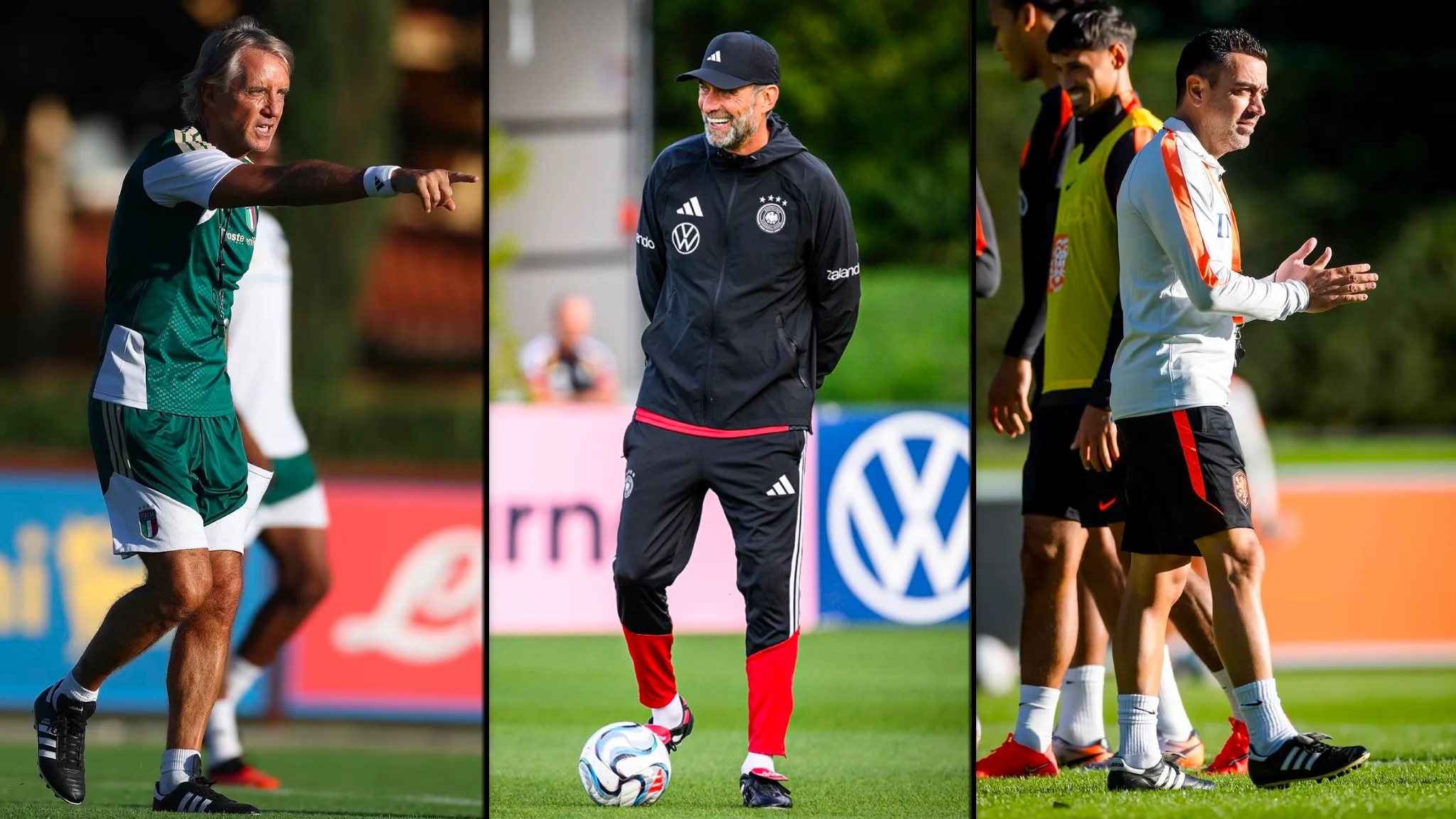
We took the squads named by ten European national teams (Belgium, Croatia, England, France, Germany, Italy, the Netherlands, Portugal, Spain and Turkey) and compared them on four measures: where the players earn their living, how old the squads are, what they are worth, and how many players are yet to make their senior debut. In the second part we turn to Italy, where Roberto Mancini’s first list of his second spell in charge included eleven first-time call-ups, and look at three young players who play their club football outside Serie A.
Squad sizes vary considerably, from 23 players for France to 43 for Germany, where Jürgen Klopp named two separate groups for his four matches. For this reason the comparisons below use shares and averages rather than totals.
Where the players play
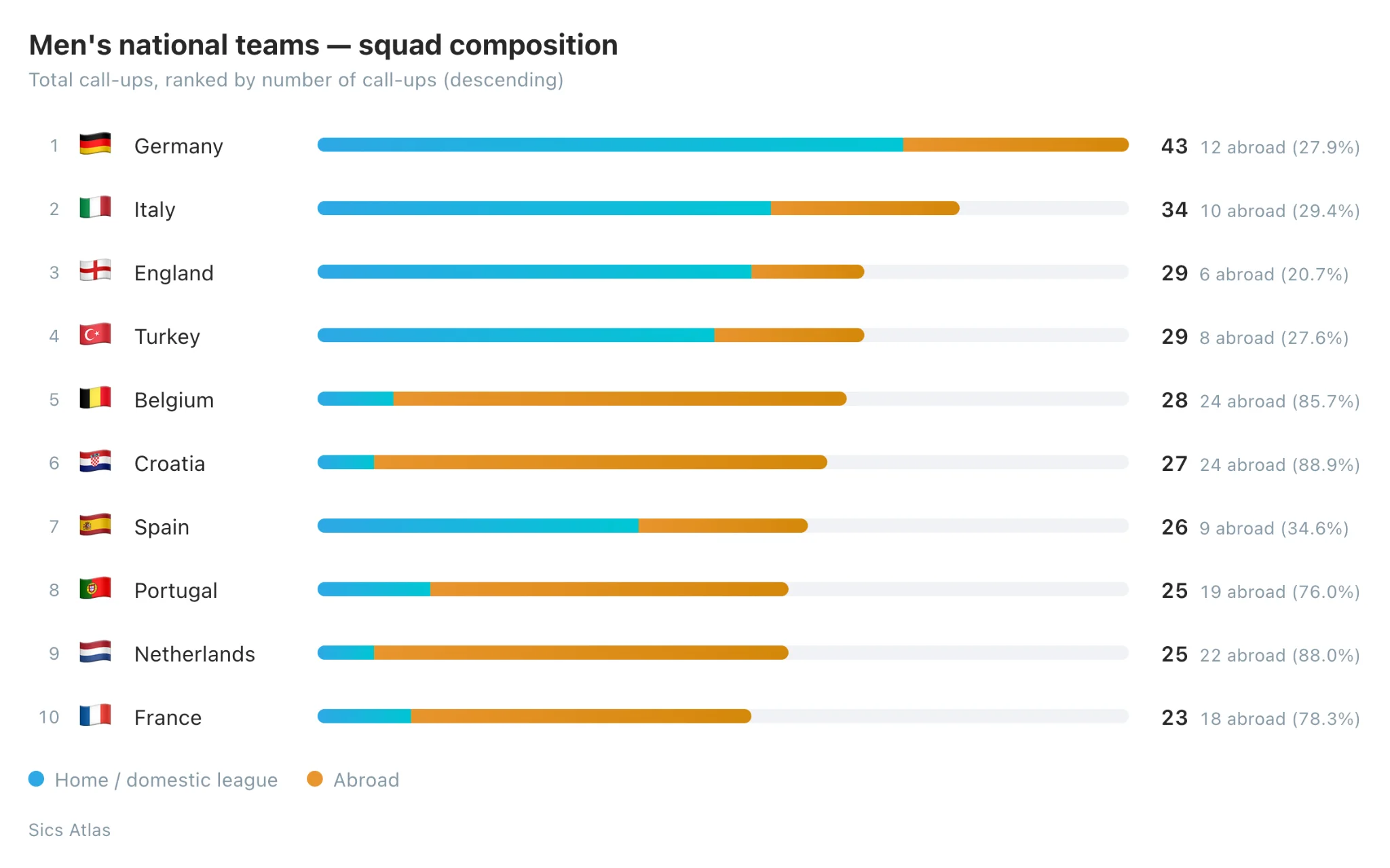
England are the clearest example of a national team built on its own league: only 6 of Thomas Tuchel’s 29 call-ups (20.7%) play outside the Premier League, the lowest share among the ten squads. The exceptions include two of the most recognisable names in the group, Harry Kane at Bayern Munich and Jude Bellingham at Real Madrid.
Turkey, Germany, Italy and Spain form a second group, with roughly two thirds to three quarters of their players based at home: Turkey 72.4%, Germany 72.1%, Italy 70.6% and Spain 65.4%.
The other five squads are built largely abroad. Croatia (88.9%), the Netherlands (88.0%) and Belgium (85.7%) have fewer than one player in six based in their domestic league, with France (78.3%) and Portugal (76.0%) not far behind. For the smaller domestic markets in this group, the call-up list reads less like a snapshot of the local league and more like a map of where their best players have been sold.
Average age: three young squads, two different reasons
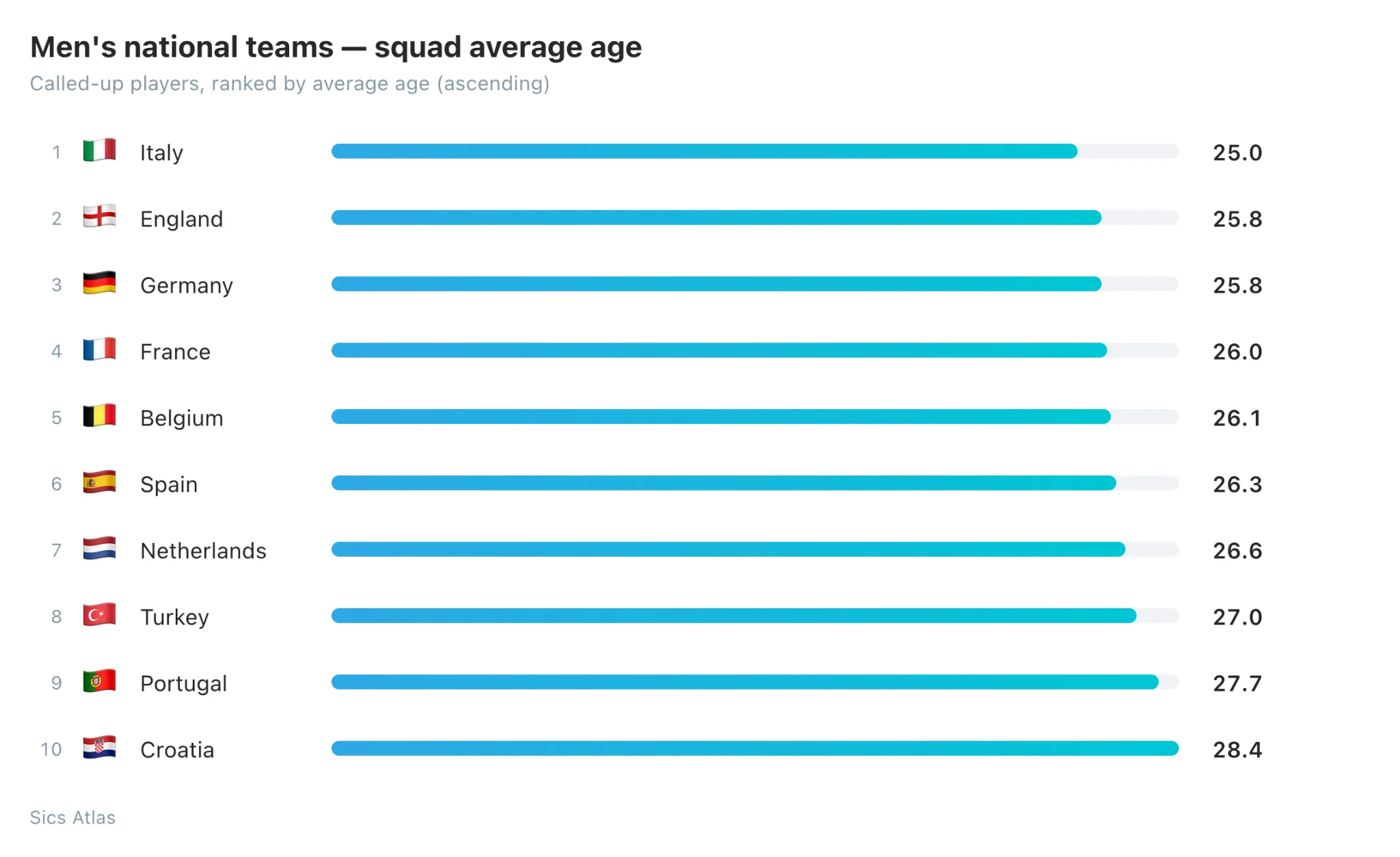
Italy have the youngest squad of the ten, with an average age of 25.0, followed by England and Germany, both at 25.8. Croatia (28.4) and Portugal (27.7) have the oldest.
The three youngest squads arrive at that figure in different ways. For Italy and Germany, a lower average age is the product of a deliberate reset after a difficult summer. Italy failed to qualify for a third consecutive World Cup, while Germany went out in the round of 32, beaten on penalties by Paraguay, and have since replaced Julian Nagelsmann with Klopp. England’s figure comes instead from a core that is already established at a young age, as the number of uncapped players in Fig. 4 confirms.
Market value: continuity at the top
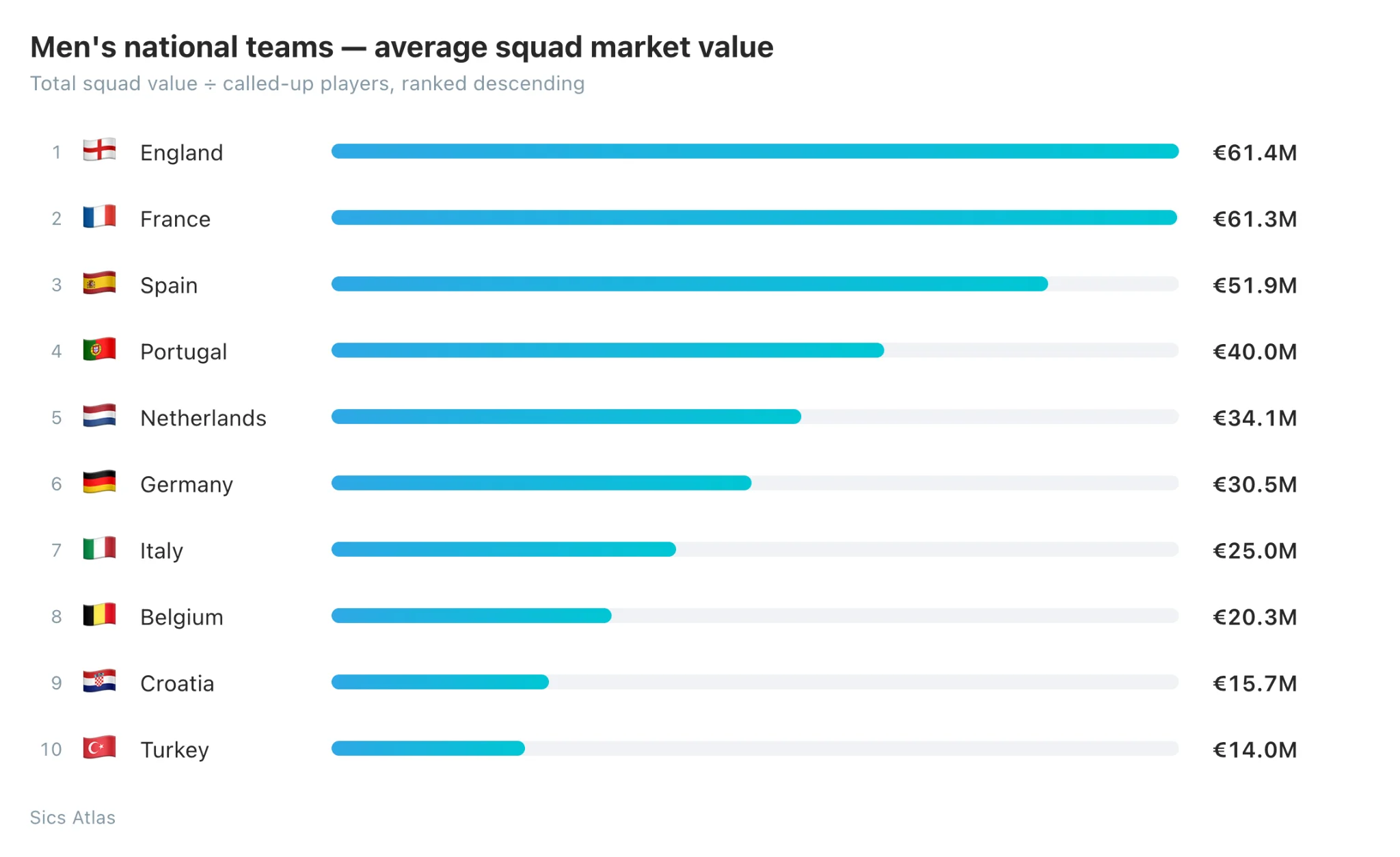
Average market value per player separates three squads from the rest: England (€61.4M), France (€61.3M) and Spain (€51.9M). Portugal (€40.0M) and the Netherlands (€34.1M) follow at a distance of more than €10M. Germany (€30.5M) and Italy (€25.0M) sit in the lower half, above Belgium, Croatia and Turkey.
Continuity explains part of the gap. Spain, the reigning world champions, and England have largely kept the core of their World Cup squads, so their averages reflect established players rather than speculative additions. France are in a similar position: Zinedine Zidane’s first squad as head coach retains 15 players from the tournament.
Uncapped players: who is looking ahead
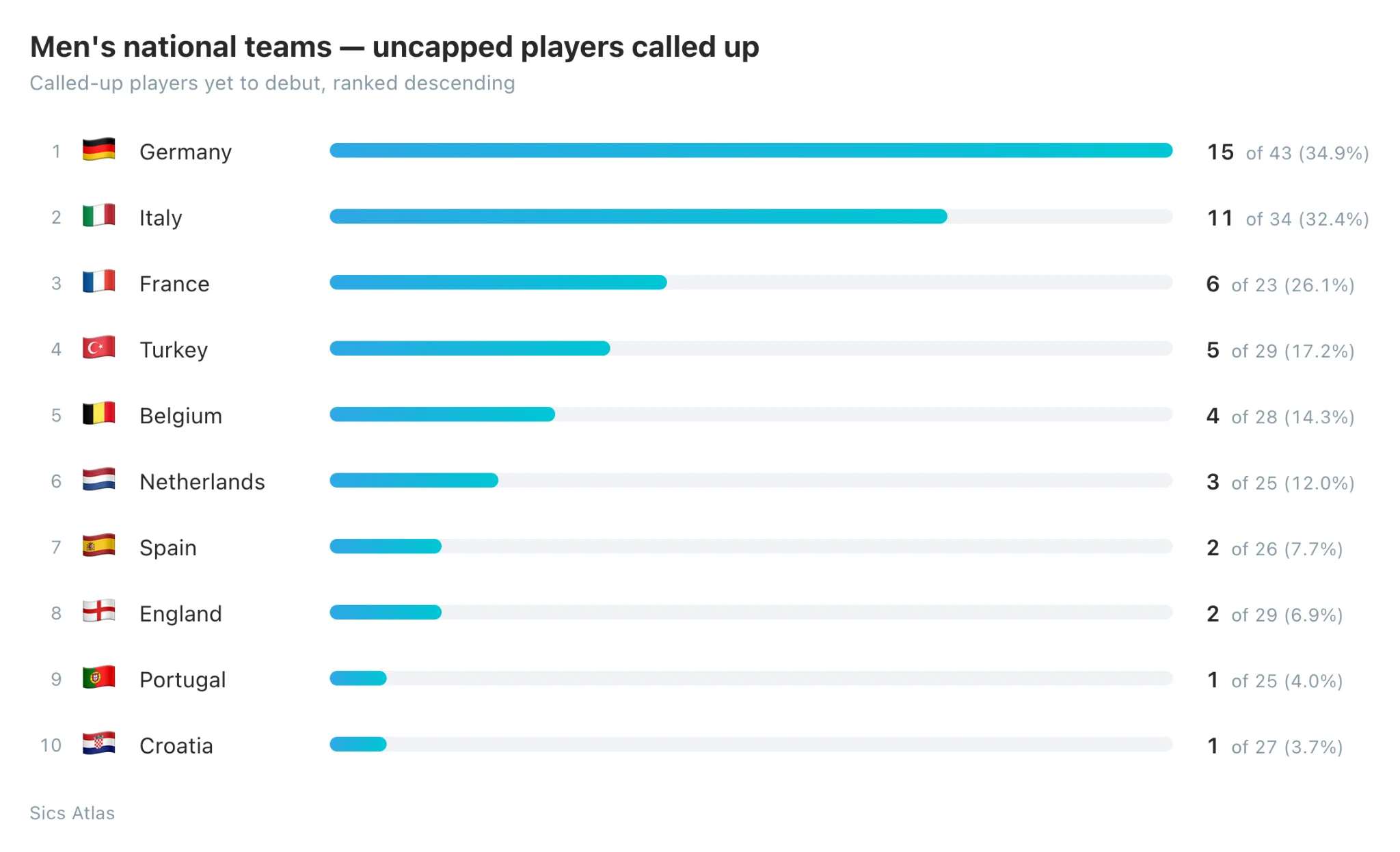
This is where Germany and Italy separate from the others, and it helps explain their position in the market value ranking. Germany have the most uncapped players, 15 across the two squads (34.9%). Klopp divided his call-ups into one group for the matches against the Netherlands and Greece and a second for Serbia and Greece, with the stated aim of seeing as many players as possible in his first window.
Italy follow, with 11 uncapped players out of 34 (32.4%). Younger, less established players carry lower valuations, even when their club performances justify the call-up.
France are third, with six uncapped players out of 23 (26.1%). Zidane’s first squad as head coach includes maiden call-ups for three Serie A players: Andy Diouf of Inter and two from Como, Lucas Da Cunha and goalkeeper Jean Butez. Even a squad with France’s depth is using this window to test what comes next. At the other end of the ranking, Portugal and Croatia have called up one uncapped player each.
Italy: three young call-ups from abroad
Mancini’s list drew attention for the number of young players and for how many of them play outside Italy: 10 of the 34 call-ups are based abroad. We selected three of them. Issa Doumbia and Mohamed Ali Zoma receive their first senior call-up in this window; Samuele Inácio, the youngest of the three, made his debut in June under Silvio Baldini against Luxembourg.
The three analyses below were produced with the AI Assistant in SICS Atlas, working on a rolling 12-month window of each player’s data. They are accompanied by a first look at the new Player Report, which will be downloadable from the platform. The report slides shown here refer to each player’s 2025/26 season and are included as a preview of the format, while the analyses in the text cover the most recent 12 months.
Issa Doumbia — Central Midfielder, Sporting CP
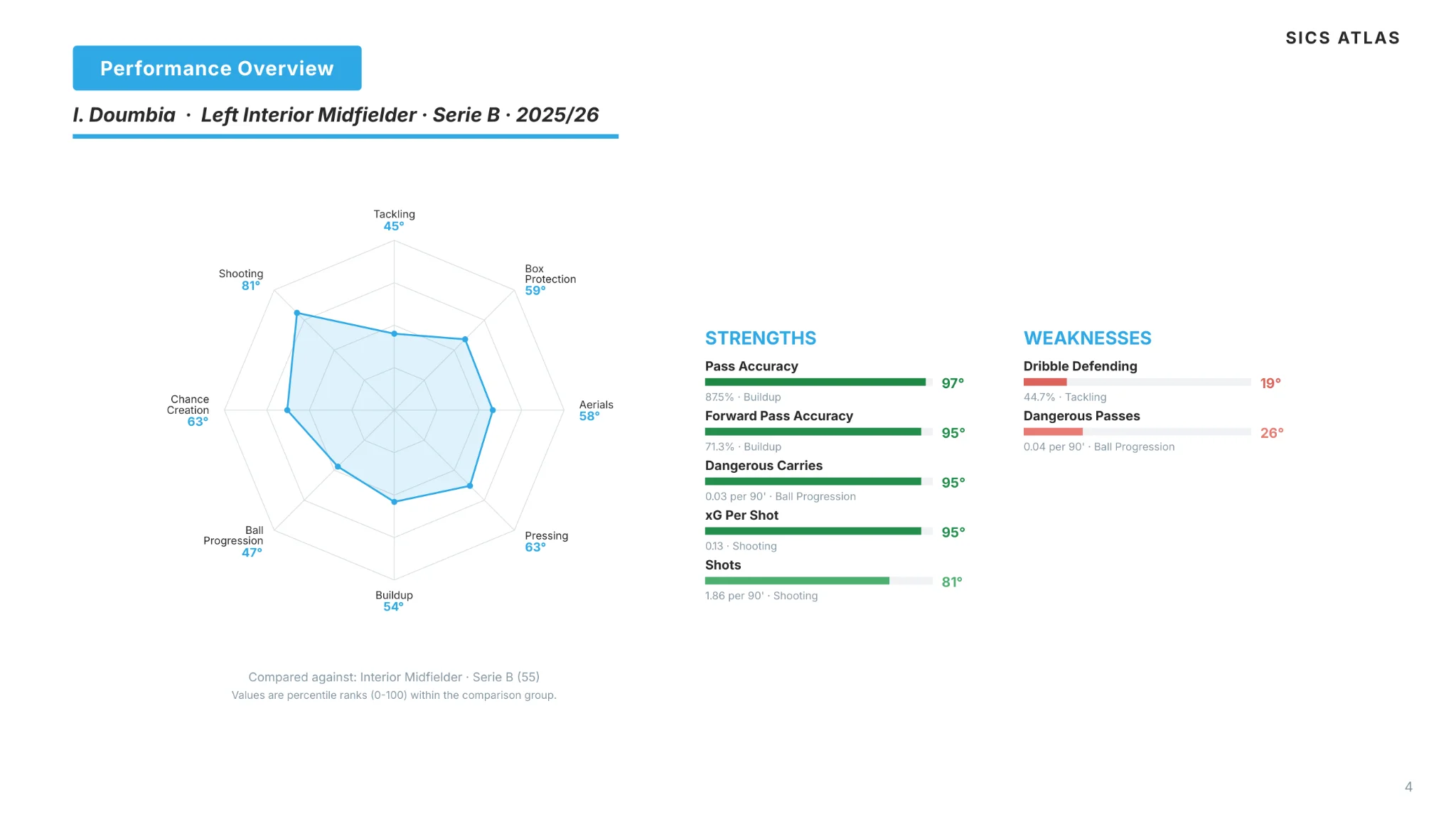
Doumbia’s last twelve months cover 41 appearances and 3,676 minutes across Serie B with Venezia, and Liga Portugal and the Champions League with Sporting. The most interesting feature of his profile is the gap between what he does with his passing and what he does when he carries the ball. His passing is accurate, 87.9% on around 40 attempts per 90, but conservative: 54% of his passes are horizontal, only 23% go forward, and the average length is 11.4 metres. The danger comes instead from his carries: 2.82 dribbles and 2.20 carries per 90, and 1.13 box entries per 90.
The most likely explanation is a combination of a preference for simple passes and his athletic profile. He records 8.18 sprints and 39.9 high-speed runs per 90, with a top speed of 35.74 km/h, and he finishes what he starts: 8 goals from 8.38 xG over the window.
The limits appear in contested situations. He wins 47.5% of his duels and 45.7% of his aerial contests, which makes him a less reliable option when a narrow lead has to be protected against crosses and second balls. He also rarely switches play, so he is not the player to open a compact low block with distribution.
The data points to a specific role: the running half of a double pivot alongside a deep distributor, in games Italy expect to play in transition, or as a substitute to raise the tempo.
Samuele Inácio — Attacking Midfielder, Borussia Dortmund
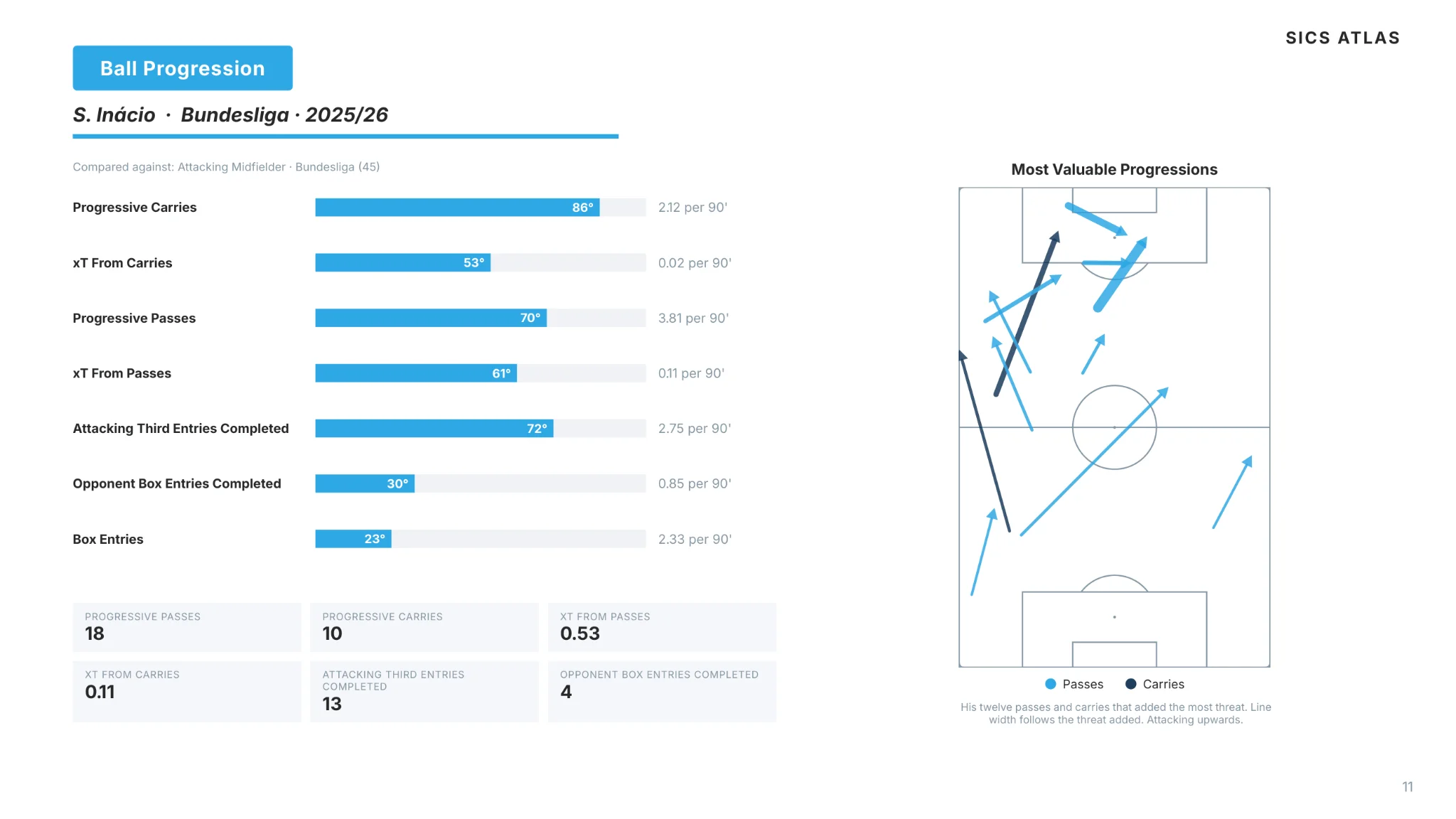
Over 18 appearances (13 starts, 1,286 minutes), Inácio has produced a goal rate uncommon for an 18-year-old attacking midfielder: 8 goals, 0.56 per 90, from 5.33 xG. The output comes from arriving in the box rather than from creating. He takes 3.36 shots per 90, 75% of them inside the area, and records 4.48 box entries per 90. He mostly starts from the left, where 422 of his 710 touches take place, and finishes centrally.
What he does not yet offer is ball security or a defensive contribution. His pass accuracy is 79.5% with 5.39 ball losses per 90, his creative output is limited (1 assist from 2.49 xA), and he wins 22.2% of his aerial duels. Two red cards in 1,286 minutes, linked to temperament rather than tackling, are the clearest reservation at senior level. He also arrives with little recent rhythm: 3 minutes across Dortmund’s last three league matchday squads.
For now, the profile is that of a finisher: a substitute to attack tiring defences in the last half hour, or a starter in games where Italy expect to control territory.
Mohamed Ali Zoma — Forward, 1. FC Nürnberg
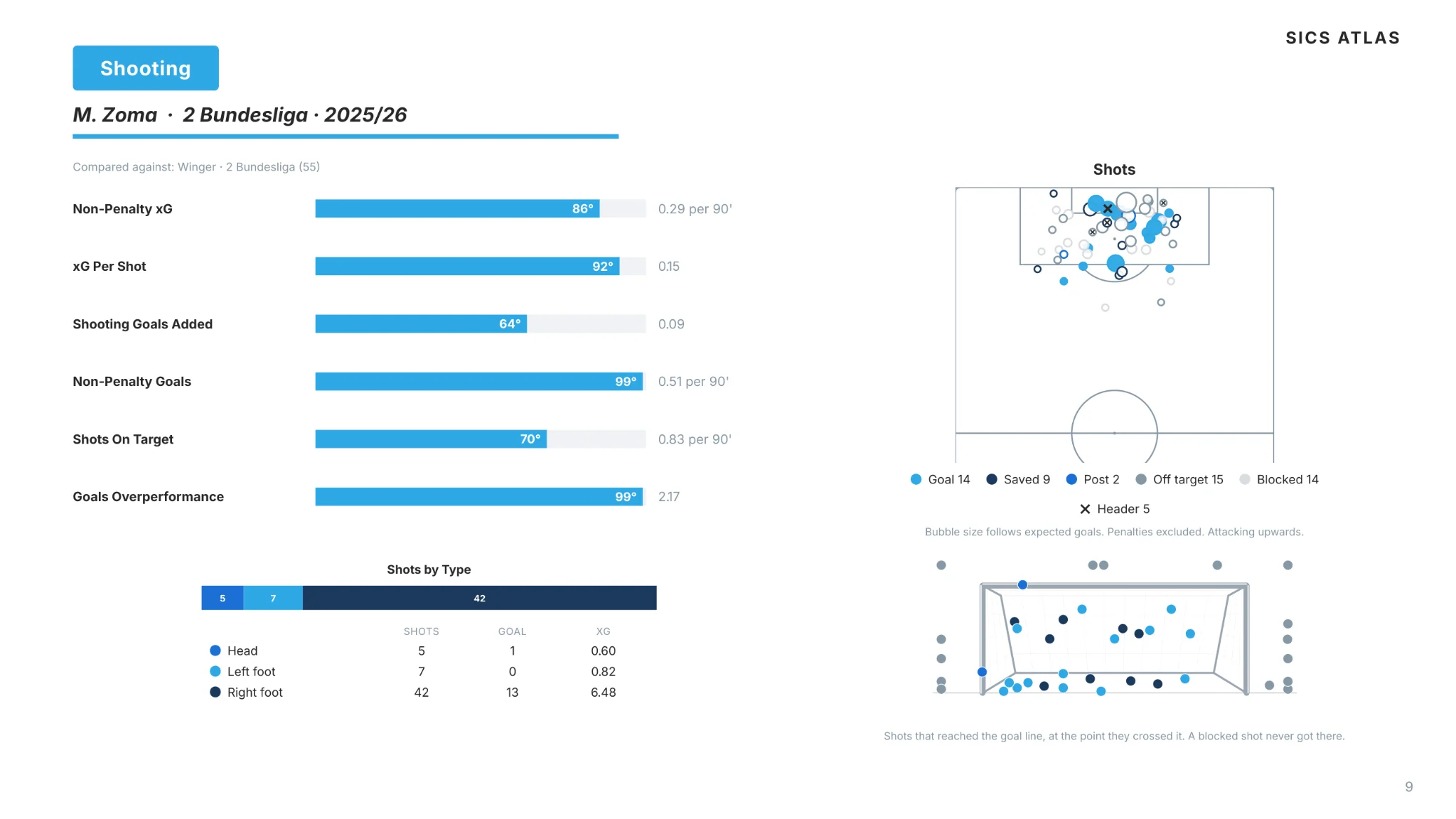
Used as a wide forward, Zoma started all 32 of his appearances (2,779 minutes) and scored 19 goals, 0.62 per 90, a very high rate for the position. His game is about ending possessions: 4.31 box entries per 90, 85% of his shots from inside the area and 4.57 dribbles attempted per 90. He is also effective after regains, with 4 goals from counter-attacks and 2 from high turnovers.
Two qualifications apply. The first is the level: the goals come in the 2. Bundesliga and the German cup, and 19 goals from 11.22 xG is an overperformance that would be expected to narrow. The second is everything that happens away from the box: 70.6% pass accuracy, 6.38 ball losses per 90, 1 completed cross from 45 attempts, and a 44.2% duel success rate. He arrives in rhythm, with 3 goals in his last six league matches, all as a starter.
The most natural fit is as a starting wide finisher in open games, within a structure where teammates carry the passing and the crossing.
Conclusion
Read together, the four charts describe two approaches to this window. England, Spain and, despite a change of coach, France have kept an established and valuable core, adding new names at the margins. Germany and Italy, the two federations among the ten coming off the most disappointing summers, have used the start of a new cycle to widen the pool, accepting a lower average value in exchange for a younger, less tested squad.
The three Italian profiles show what that choice looks like at player level: clear, usable strengths alongside equally clear gaps, from players still developing outside Serie A. The Nations League matches over the next two weeks will give a first indication of which of these call-ups become part of the next cycle.