Inside Serie A's Frozen Market

Introduction
This time we're turning to calciomercato, right in the busiest stretch of the summer transfer window. We're starting with Serie A, currently going through one of its most difficult windows in recent memory. Italian clubs are struggling to close deals that look straightforward on paper, largely for economic reasons, and by most historical measures this is shaping up to be one of the more immobile markets Italian football has seen in some time.
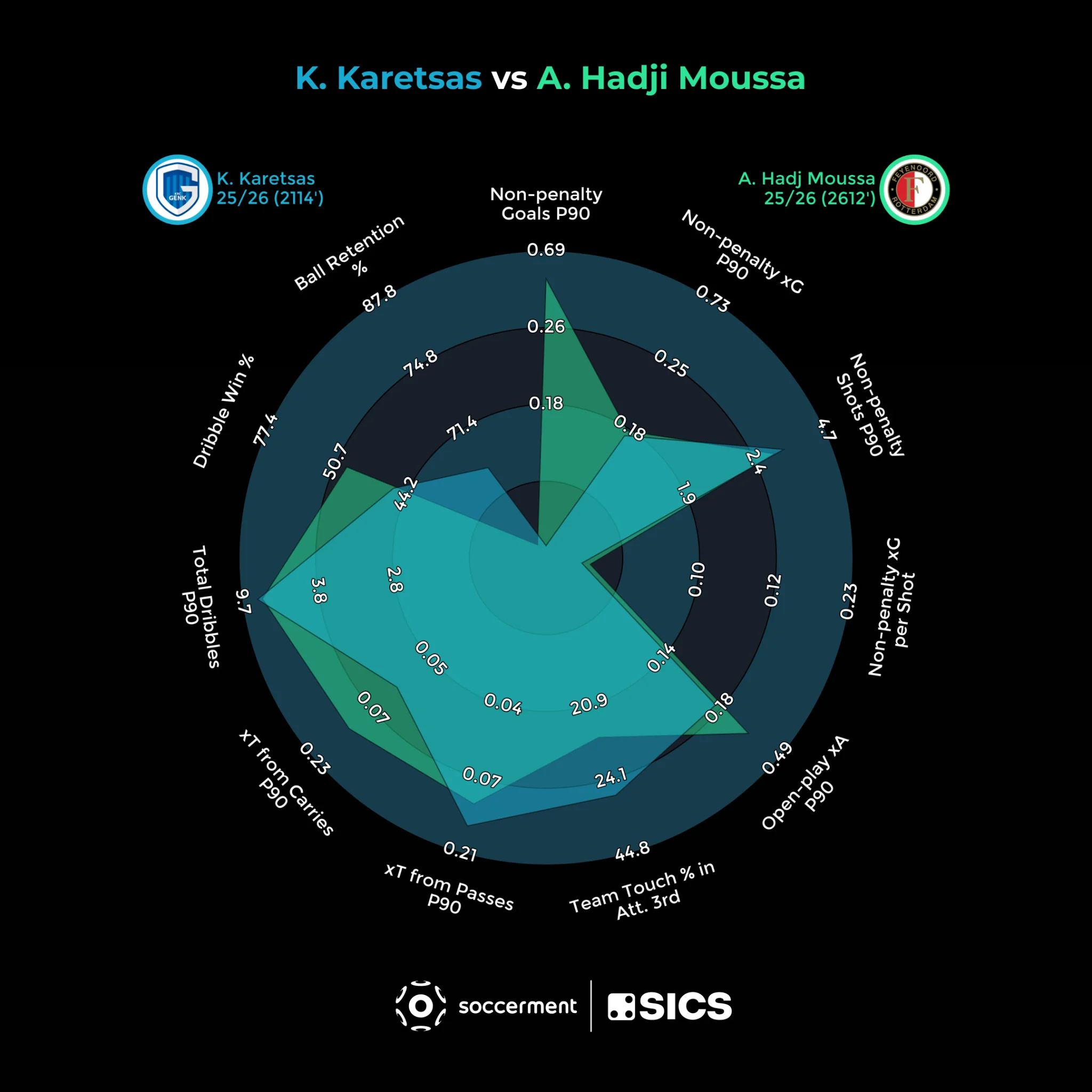
For this edition we picked three of the league's most representative clubs, Juventus, Inter and Milan, and identified, for each one, the single transfer objective generating the most attention right now. From there we used data to build three alternative profiles per club: players whose statistical output could answer the same need, regardless of how realistic a move for them currently looks. We searched for those candidates across what we refer to internally as the Top 9 leagues, the traditional top five (Premier League, LaLiga, Bundesliga, Serie A and Ligue 1) plus Belgium, Portugal, the Netherlands and Turkey. Each radar chart below compares the candidate directly to the player their club is looking to replace (Vlahović, Dumfries or Karetsas, depending on the section), rather than to a positional league average. We'll apply the same search approach to other leagues in the coming weeks.
The three cases below cover different kinds of urgency. Juventus need a genuine centre-forward after Vlahović's departure. Inter's need at right wing-back has become pressing after two separate deals collapsed. Milan recently lost their declared target for the number ten role and had to look elsewhere. In each case we've tried to mix feasible operations with longer-term bets, and in some instances a more established name further up the market.
Replacing Vlahović: Juventus' search for a true number nine
With Dušan Vlahović's contract expired and no renewal agreed, Juventus enter the summer window needing a genuine centre-forward. A deal for Randal Kolo Muani from Paris Saint-Germain is reportedly in its closing stages, but that alone will not close the search. Lois Openda has already been sold, and Juventus do not appear ready to build the attack around Jonathan David after a difficult first season in Turin. With the forward line thinning out, the club is known to be looking at a further number nine on the market.
Coach Luciano Spalletti has been vocal about what he wants from that position, and his comments on Vlahović double as a specification of the profile he is after. Speaking after Juventus' win at Lecce, Spalletti said the team had missed a genuine physical focal point, arguing that "you cannot play without a physical terminal if you want to be a winning side." He described a striker capable of receiving the ball under pressure with his back to goal, holding it up, and relieving pressure on the rest of the team, in turn opening space for creative players such as Kenan Yıldız to exploit. He also pointed to Vlahović's ability to win the physical duel inside the box and score from it, distinguishing him from lighter, more purely associative forwards. Beyond the physical profile, Spalletti praised the clarity of the role Vlahović occupies, calling him a player with well-defined, "centred" characteristics rather than a jack of all trades, and pointed to his competitive temperament as a key part of what the team is losing.
The profile: what makes Vlahović hard to replace
According to Soccerment's player clustering model, Vlahović sits at the intersection of two archetypes: 70% Target Man and 30% All-round Finisher, a combination that makes him one of the more distinctive centre-forwards in European football.
A Target Man is a physically dominant striker who operates primarily inside the penalty area, excelling in aerial duels, attacking crosses and receiving a high volume of passes in dangerous zones. These forwards typically contribute less to chance creation, but still play a role in build-up through hold-up play and layoffs for runners.
An All-round Finisher represents a more contemporary interpretation of the number nine: still a high-volume shooter with strong underlying numbers, but more involved outside the box, contributing final-third passes and link-up play without giving up goalscoring threat.
Few forwards combine elite physical presence with consistent penalty-box output and a genuine contribution in possession, which is why a direct like-for-like replacement is difficult to find. Instead, Juventus may need to decide which facet of Vlahović's game to prioritise. The three profiles below, drawn from Soccerment's clustering model alongside key underlying metrics (non-penalty expected goals per 90, penalty-box touches per 90 and expected assists received), each address a different part of that decision.
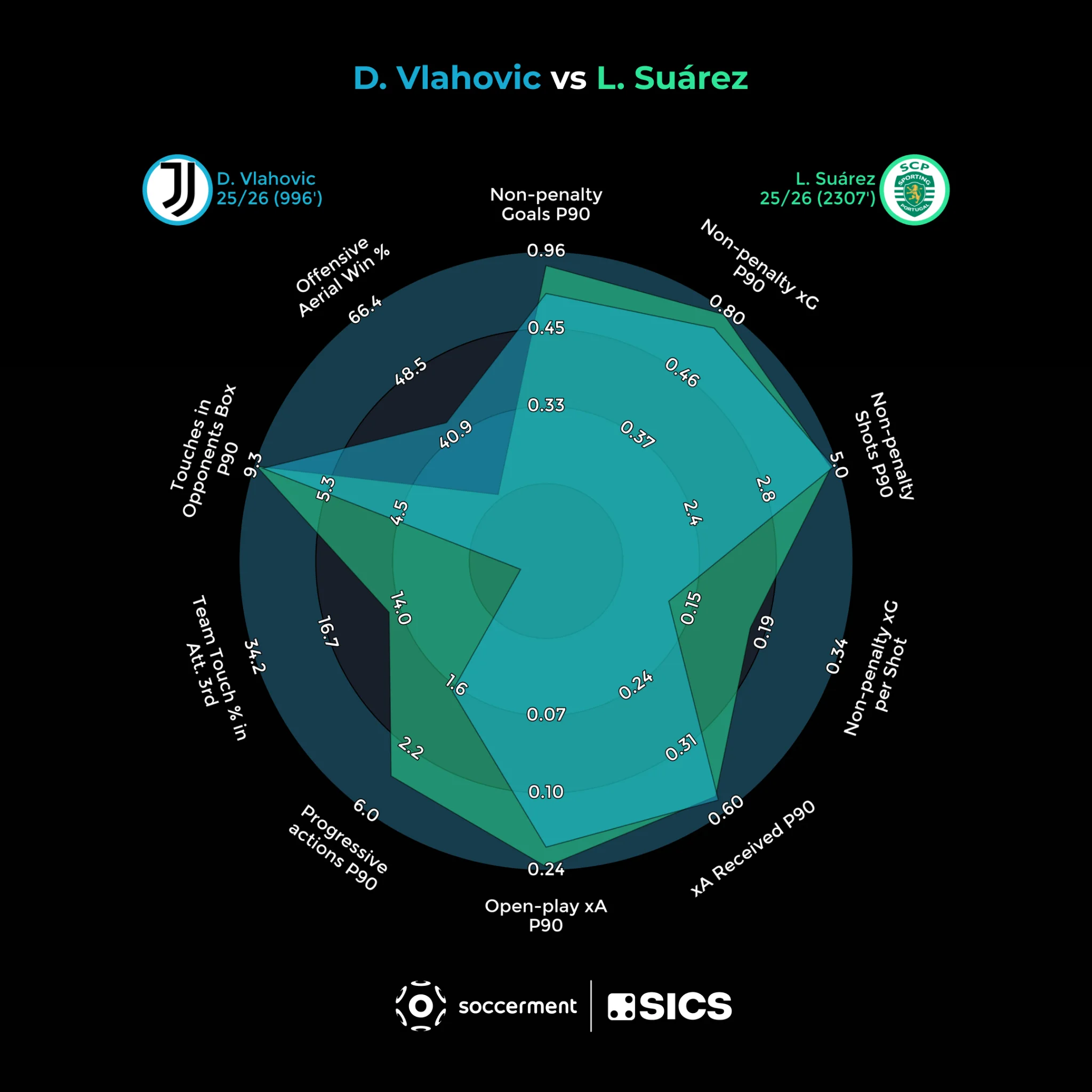
Luis Suárez (Sporting CP)
If the priority is maximising immediate goalscoring output, Suárez is the clearest candidate. Already in his prime at 28 y/o, the Colombian arrives with proven numbers behind him: 38 goals in 53 appearances last season for Sporting.
At 179cm he cannot match Vlahović's aerial presence, but he compensates through movement inside the box. His non-penalty xG per 90 and penalty-box touches per 90 are among the highest of the three profiles here, reflecting a striker who consistently gets into high-quality scoring positions.
In terms of link-up play, his xA received numbers sit close to Vlahović's, indicating he is regularly targeted as the focal point of his team's attack. He also offers a touch more in creation than a typical number nine, finishing the season with nine assists. At around €30 million, he is not the youngest option on this list, but he is arguably at the peak of his powers and could provide an immediate scoring return.
Romulo (RB Leipzig)
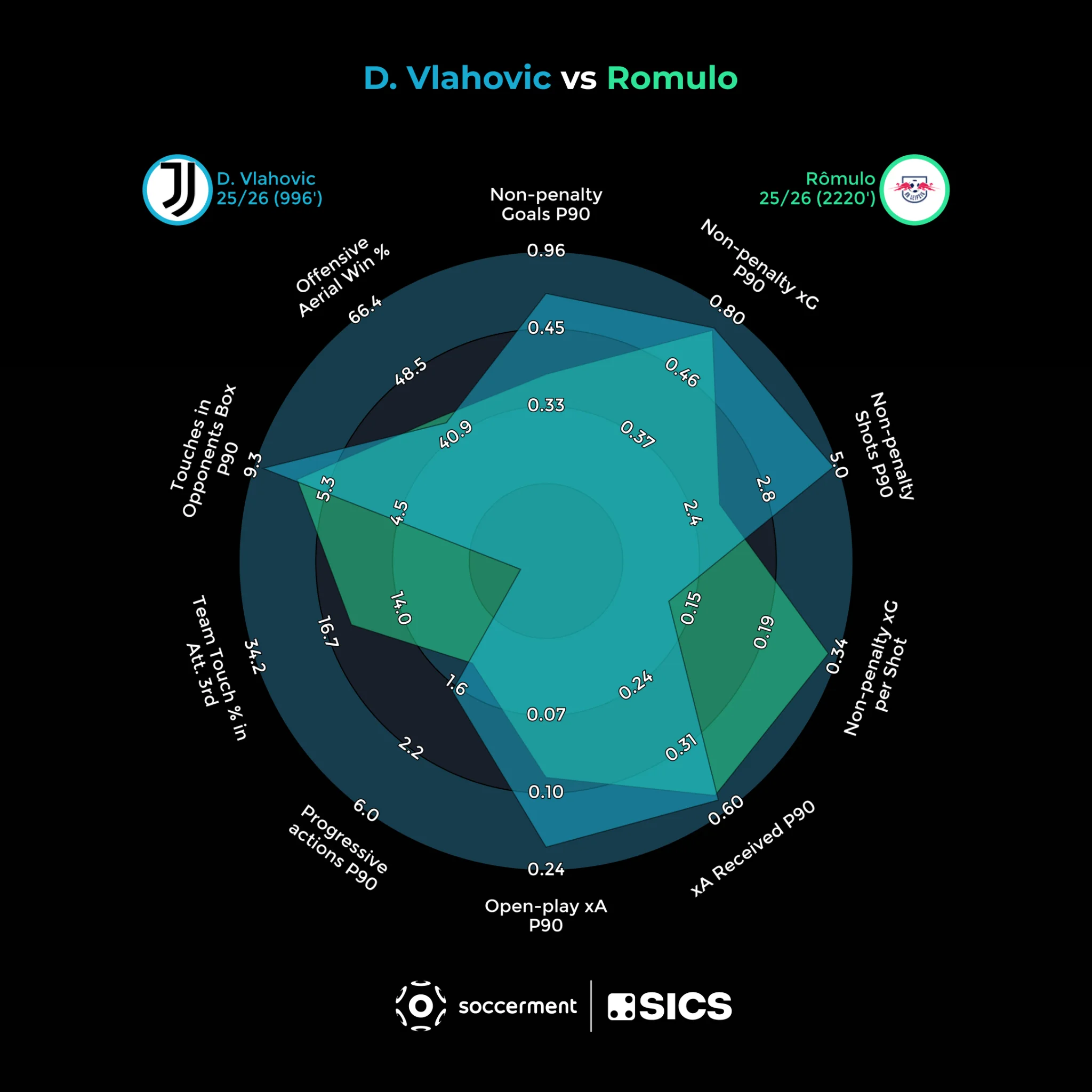
Romulo is statistically the closest match to Vlahović among the three candidates. The 24-year-old scored nine goals and provided four assists for Leipzig last season, following 13 goals in the Turkish Süper Lig the year before.
Soccerment's clustering model places him as 65% Target Man and 35% Mobile Finisher, close enough to Vlahović's own split to make the comparison meaningful. The two post very similar numbers for penalty-box touches per 90 and non-penalty xG per 90, and both record high values for xA received, suggesting Romulo is used, much like Vlahović at Juventus, as the reference point his teammates look for in dangerous areas.
Carlos Espí (Levante)
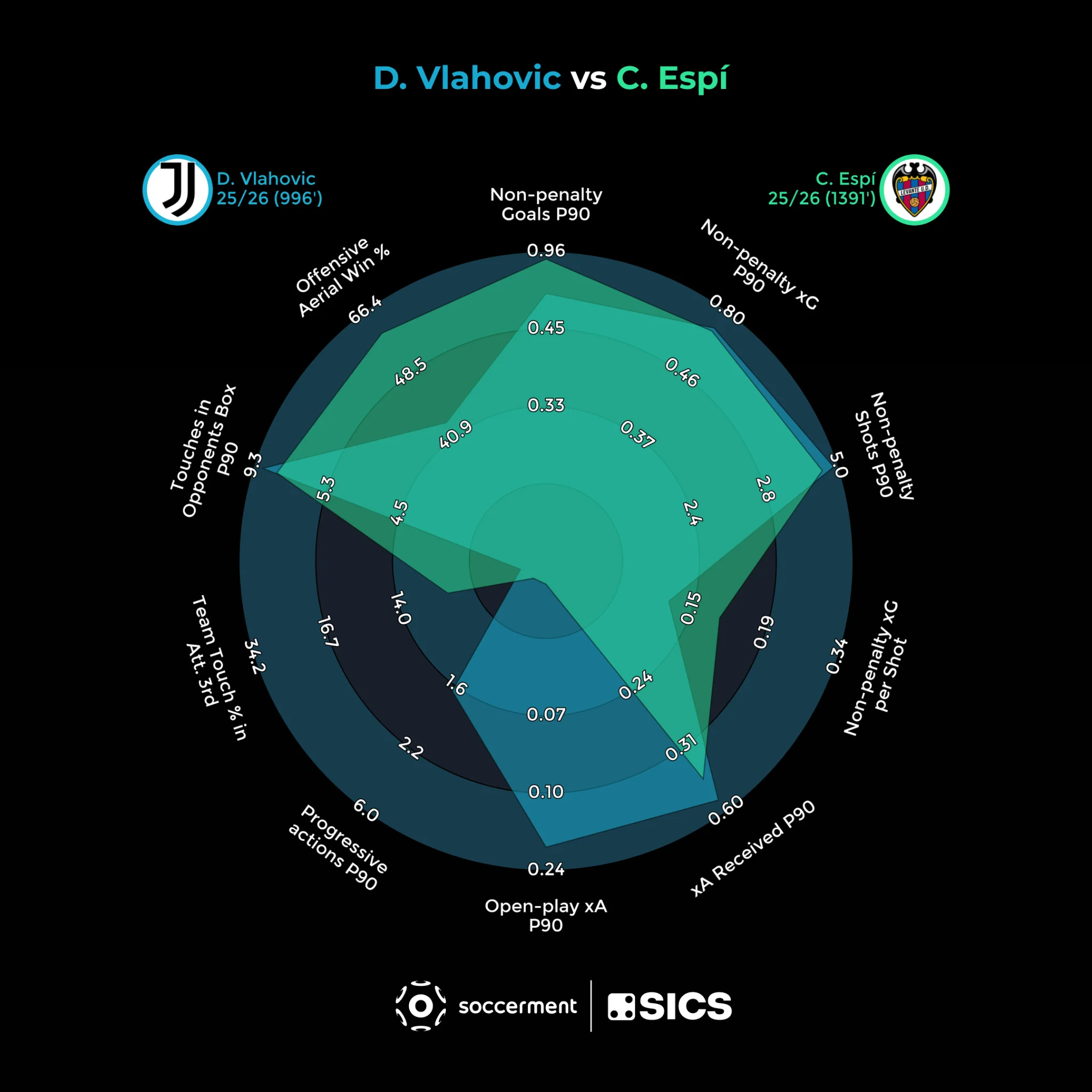
The third option is a longer-term investment rather than an immediate solution. Espí, born in 2005, scored 11 goals in just 25 appearances last season despite a disrupted campaign: limited early minutes were followed by an injury layoff, before he became a key figure in Levante's run to safety in the second half of the season.
Soccerment's model classifies him as 81% Target Man and 19% Mobile Finisher, a split heavily shaped by his physical frame and his success rate in the air. Statistically he mirrors Vlahović in shooting volume, expected goals and xA received, showing a similar ability to convert the chances created around him.
The clearest gap is in creative contribution: Espí recorded just 0.4 xA over the season, well below Vlahović's own output, marking him out as closer to a pure finisher than a forward expected to link play. That narrower profile is also what makes him a development bet rather than a ready-made alternative.
Replacing an outlier: Inter's search for Dumfries' successor
Inter's need at right wing-back became urgent the moment Denzel Dumfries was sold to Real Madrid. The club appeared close to signing Palestra from Atalanta before he moved to Chelsea instead, and a deal for Kalaili from Union Saint-Gilloise collapsed after he failed his medical. Two attempts, two setbacks, and a role that still needs filling before the season starts.
Replacing Dumfries is arguably harder than replacing a conventional wing-back. Although he built that profile as the right wing-back under Simone Inzaghi's 3-5-2, Soccerment's clustering model classifies him as 91% Chance Creator, an exceptional profile for a player in that position. The Chance Creator cluster is typically associated with attacking midfielders and creative forwards: players who rank among the best for passes in the opposition half and final third, through balls, passes into the box and chances created, acting as the link between build-up and finishing. Many occupy the number ten role, others perform the same function from wide areas or even as centre-forwards.
Dumfries is a genuine outlier in that respect. Rather than fitting the mould of a defensive-minded wing-back, he provided the attacking output usually expected of a creative player while still occupying a defensive starting position, which makes him unusually difficult to replace: few players offer that level of offensive production from the right flank. Because Dumfries missed a significant part of last season through injury, his statistical profile, and those of the candidates compared against him, is drawn from the last two seasons for a more representative picture.
Given this, Inter's priority should probably be a wing-back capable of shaping play in the final third, rather than one selected primarily for defensive solidity. Three profiles stand out on that basis.
Rodrigo Gomes (Wolverhampton Wanderers)
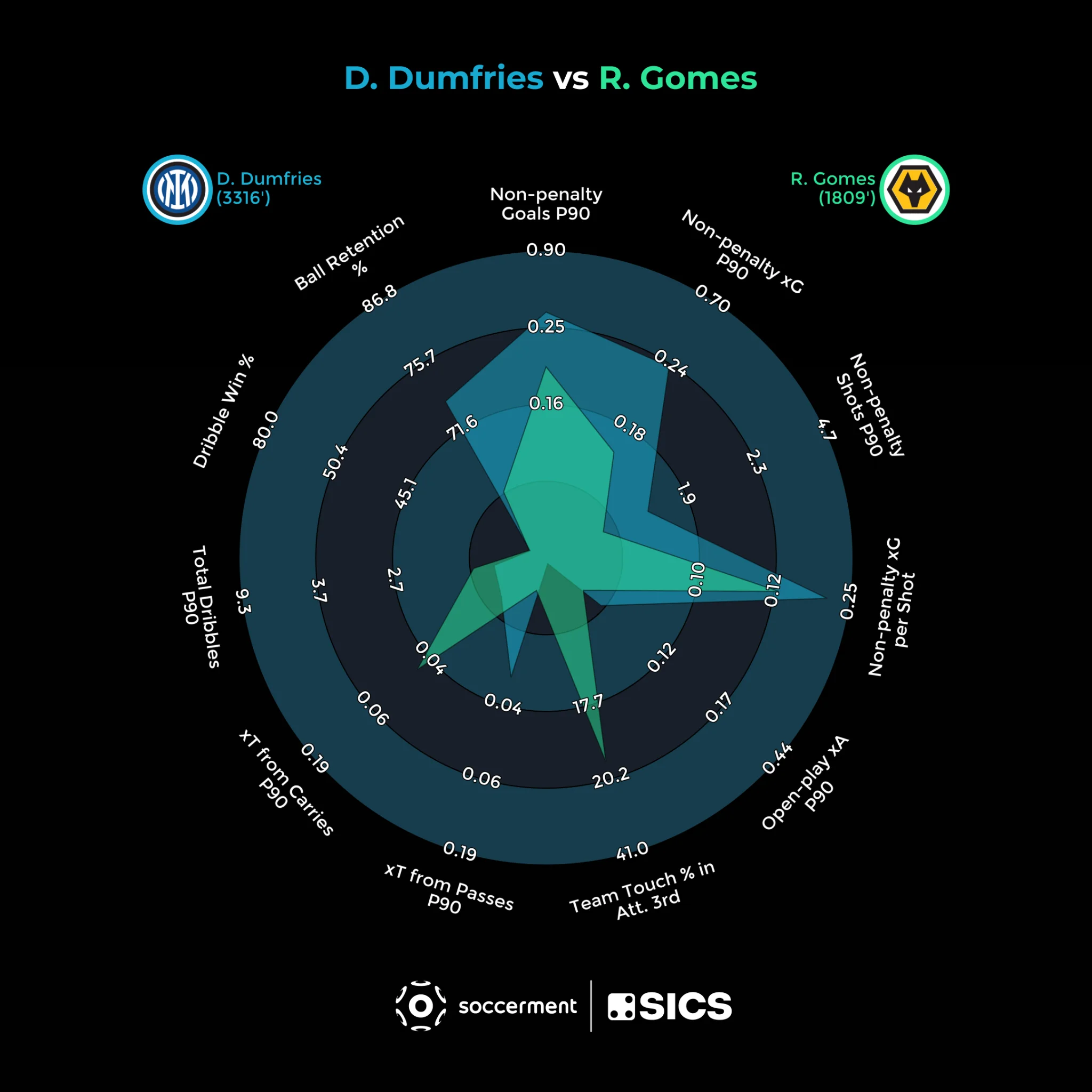
Gomes is an attack-minded wide player who, like Dumfries, is comfortable on either flank. He has scored 33 goals across his career, including nine during the 2023/24 season, a level of final-third contribution that is unusual for the position.
Having already adapted to the physical demands of the Premier League, he could find Serie A's slower tempo and greater tactical structure a good fit. One of the clearest overlaps with Dumfries is non-penalty xG per shot, where both post high values, meaning both tend to shoot from good positions close to goal rather than settle for speculative attempts from distance. That reflects strong movement into dangerous areas and good timing when arriving in the box, one of the defining traits of Dumfries' game at Inter.
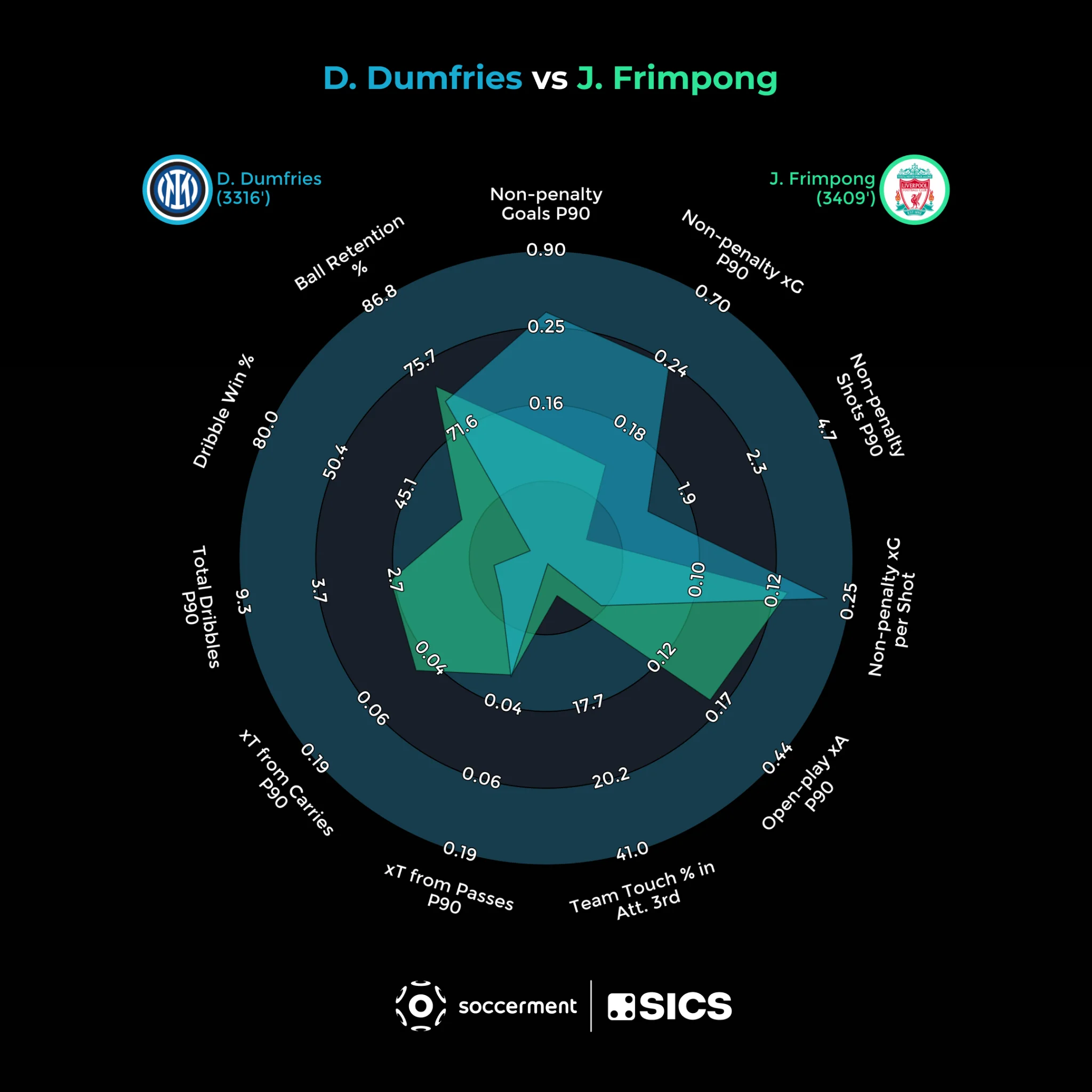
Jeremie Frimpong (Liverpool)
Frimpong is by far the most established name among the three candidates. Liverpool paid around €40 million to sign him from Bayer Leverkusen after a strong final season there, five goals and five assists, but his first year at Anfield has been sporadic and short of expectations.
A move to Inter could be the chance to reset. Cristian Chivu's 3-5-2 has continued to get strong attacking output from the wing-back positions, and Frimpong's profile fits that role well. Prising him away from Liverpool would not be straightforward, but at 25 he is still entering his prime years and would represent a genuine top-level addition. His radar points to a player far more involved in ball progression and carrying than Dumfries, relying less on penalty-box arrivals and finishing. He lacks Dumfries' physical presence, but his pace and technical quality on the ball compensate. Across his career he has produced 38 goals and 61 assists, underlining the scale of attacking threat he brings from wide areas.
Juanlu Sánchez (Sevilla)
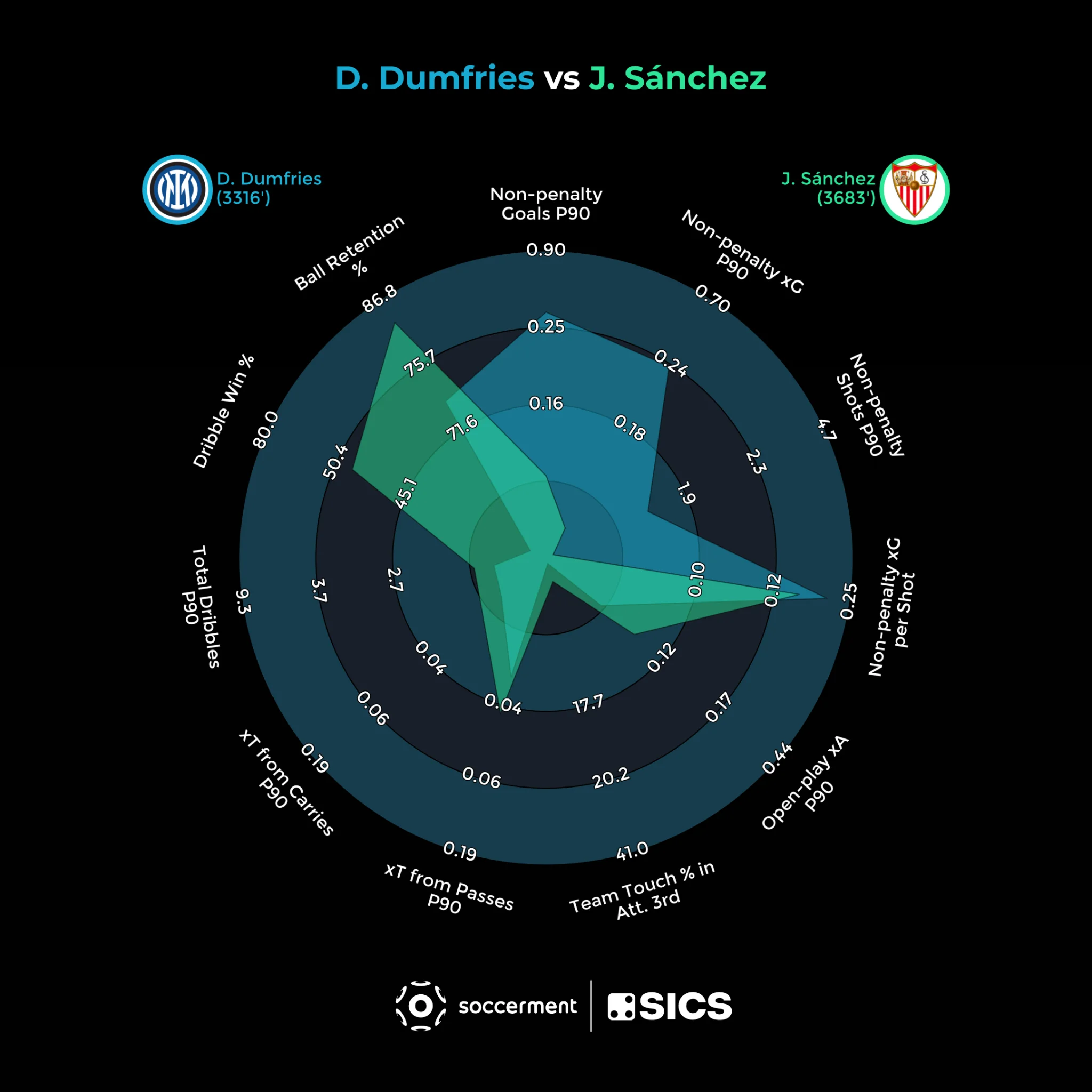
For a younger and more affordable alternative, Juanlu is worth watching. His goalscoring record is modest, four goals in 91 La Liga appearances, but that largely reflects his role as a right-back in a back four for most of his senior career. Earlier in his development he regularly played as a right winger, which suggests he could adapt comfortably to a more advanced wing-back role in a 3-5-2.
Statistically he stands out for his dribble success rate and his contribution to ball progression, posting strong numbers for expected threat and expected assists. Perhaps the most interesting overlap with Dumfries is non-penalty xG per shot, where the two are very close despite Juanlu's more defensive starting position, suggesting he already times his forward runs well and gets into good shooting positions inside the final third.
The missed target: Milan's search for a new number 10
Milan's declared priority for the summer had a name attached to it, Kōnstantinos Karetsas of Genk, but the Belgian club has now sold him to Borussia Dortmund. Rúben Amorim still needs a left-footed attacking midfielder to operate alongside Christian Pulisic behind Gonçalo Ramos in his preferred 3-4-2-1, and with the market currently short on fresh rumours for the role, the search has effectively reopened.
The profile Amorim is after is not a traditional number ten. It is a player capable of receiving between the lines, progressing the ball through carries and passes, creating chances consistently, and offering a goalscoring threat when cutting inside onto a stronger left foot. With Pulisic expected to attack space from the opposite flank, the new signing would need to dictate play in the final third while also supplying creativity from the right half-space.
Three names fit that brief in different ways.
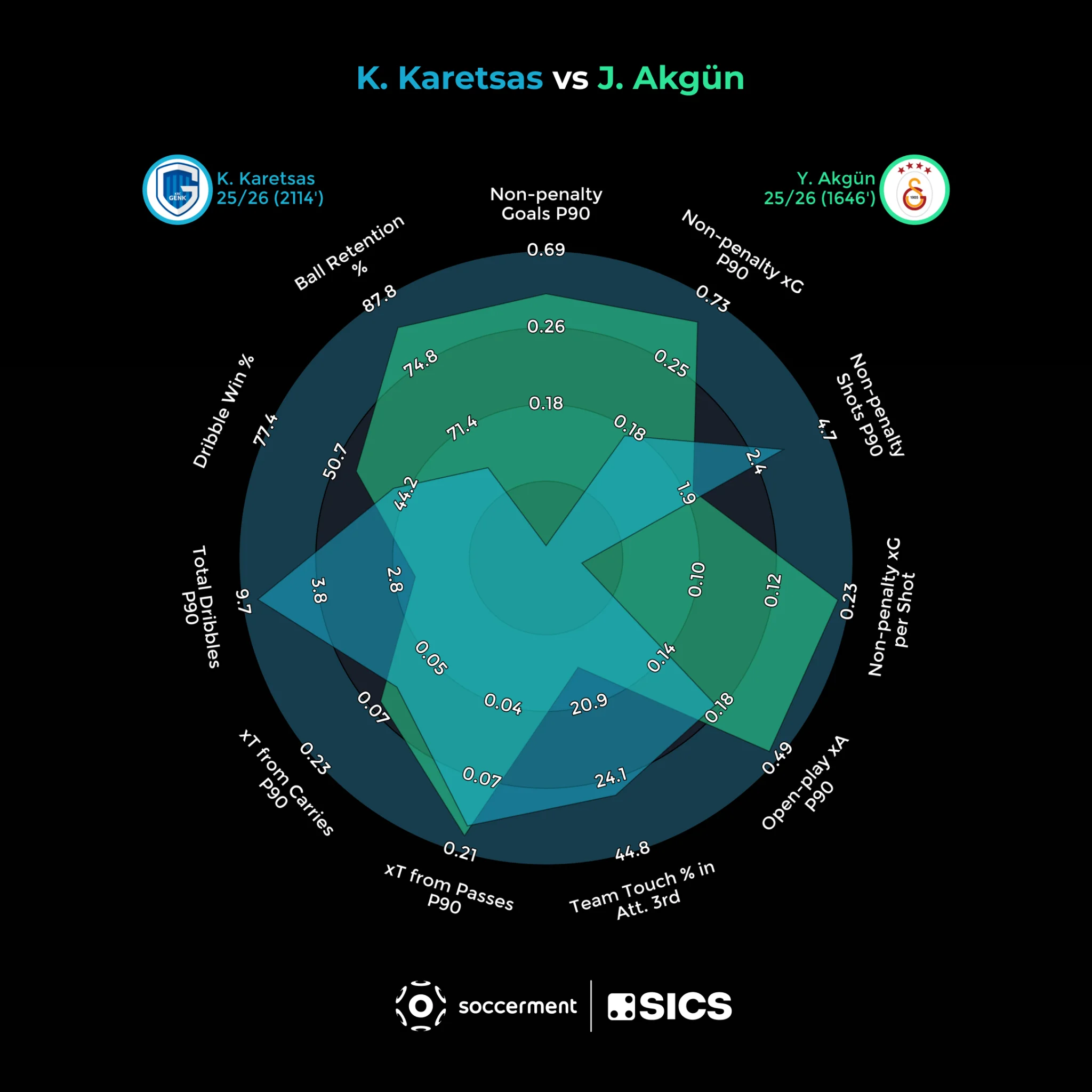
Yunus Akgün (Galatasaray)
Akgün remains somewhat underrated given the level of creative output he has produced over the last two seasons. Last season he recorded seven goals and 11 assists in roughly 1,900 league minutes, almost matching his numbers from the year before and showing a rare level of consistency for a player his age.
Statistically he is a genuine ball progressor, ranking highly for expected threat generated through both passes and carries, and sitting among the best creators in Europe for open-play expected assists per 90. Rather than relying purely on dribbling, he consistently moves possession into dangerous areas before setting up teammates. At 26 he may not offer the long-term upside of a younger prospect, but he looks to be entering the peak years of his career, and for a moderate fee Milan could add a player capable of an immediate impact on Amorim's attacking structure.
Geny Catamo (Sporting CP)
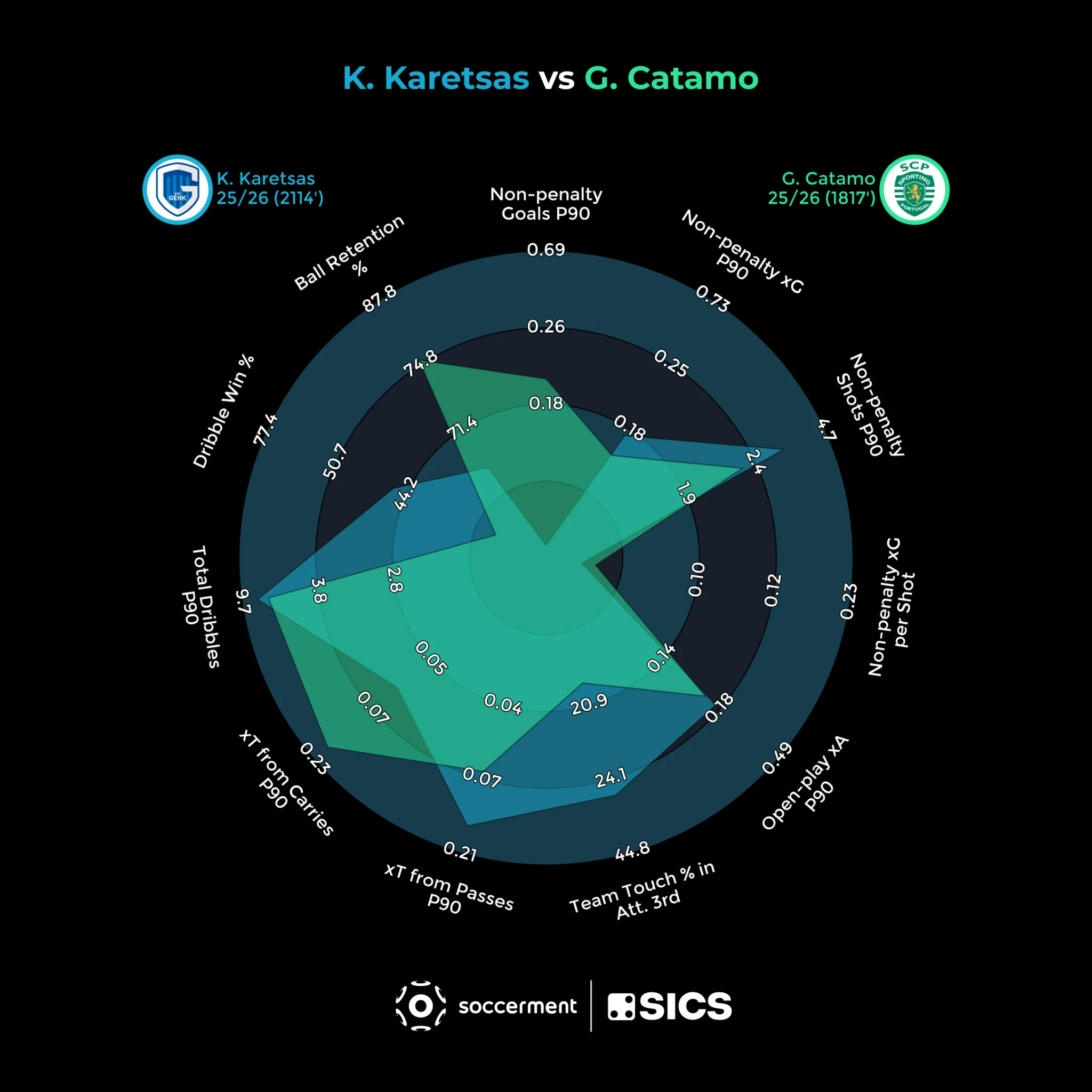
For a more explosive, dribble-oriented option, Catamo stands out. He already knows Amorim's tactical demands from playing under him at Sporting, which should ease any adaptation period considerably.
His greatest strength is beating defenders in one-versus-one situations and carrying the ball into advanced areas, with dribbling volume and progressive carries among the defining features of his statistical profile, a natural fit for a system that asks its attacking midfielders to operate dynamically between the lines. His end product still has room to grow: last season he contributed six goals and four assists in the Portuguese league, plus a goal and an assist in the Champions League. Given his familiarity with Amorim's methods, he could realistically compete for a starting role from the outset.
Anis Hadj Moussa (Feyenoord)
The third option had an outstanding campaign at Feyenoord, finishing the Eredivisie season with 11 goals and six assists, plus two more goals in the Europa League. Although he has mostly played as a right winger, Hadj Moussa is naturally left-footed and prefers cutting inside onto his stronger foot, which suits the right-sided attacking midfield role in Amorim's system well.
His radar immediately highlights two standout traits: a strong willingness to dribble and excellent ball-carrying ability. One notable figure, however, is his non-penalty xG per shot, which is markedly lower than the other two candidates, meaning he often shoots from more difficult positions rather than relying on high-quality chances close to goal. Despite that, he dramatically outperformed his underlying numbers, scoring 11 league goals from just 5.2 non-penalty xG, a sign of high-quality finishing on difficult attempts. His creative numbers tell a similar story: he produced 8.8 expected assists but registered only six actual assists, suggesting his teammates failed to convert a meaningful share of the chances he created. With more clinical finishers around him, that assist tally could look very different.
Conclusion
Three clubs, three different needs, and in each case a target that either already moved elsewhere or never quite closed. What connects them says less about any single position and more about the state of Serie A's market this summer: even well-defined, publicly known targets are proving difficult to land, and clubs are having to build contingency plans in real time rather than execute a first-choice deal. The alternatives outlined above range from realistic to aspirational, but all three clubs will need one of these decisions to land before pre-season commitments start to bite. We'll bring the same data-led approach to another league in the coming weeks.