Italy's Wake-Up Call: The Structural Problem and the Players Who Could Help Solve It
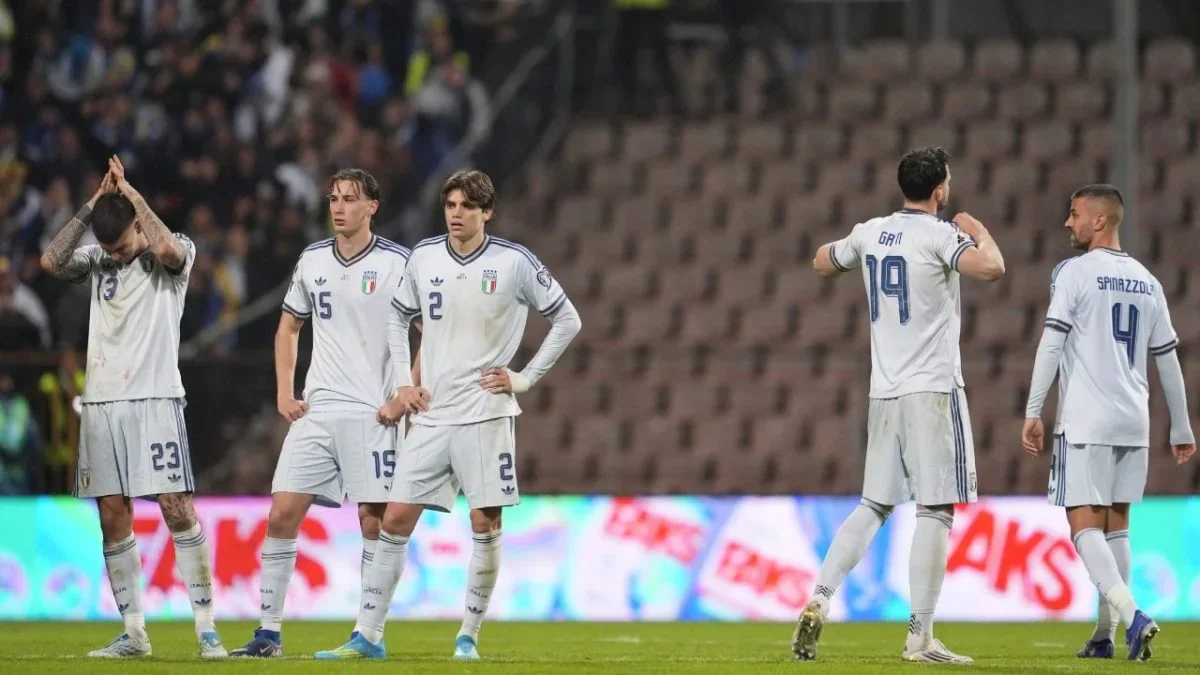
Italy's failure to qualify for a third consecutive World Cup has prompted a new round of resignations and post-mortem analysis. In this analysis, we compare the usage of domestic players in Serie A with the rest of the top 5 European leagues, and showcase some young Italian players across different roles who might go on to form the backbone of the national team in the near future.
Domestic players usage
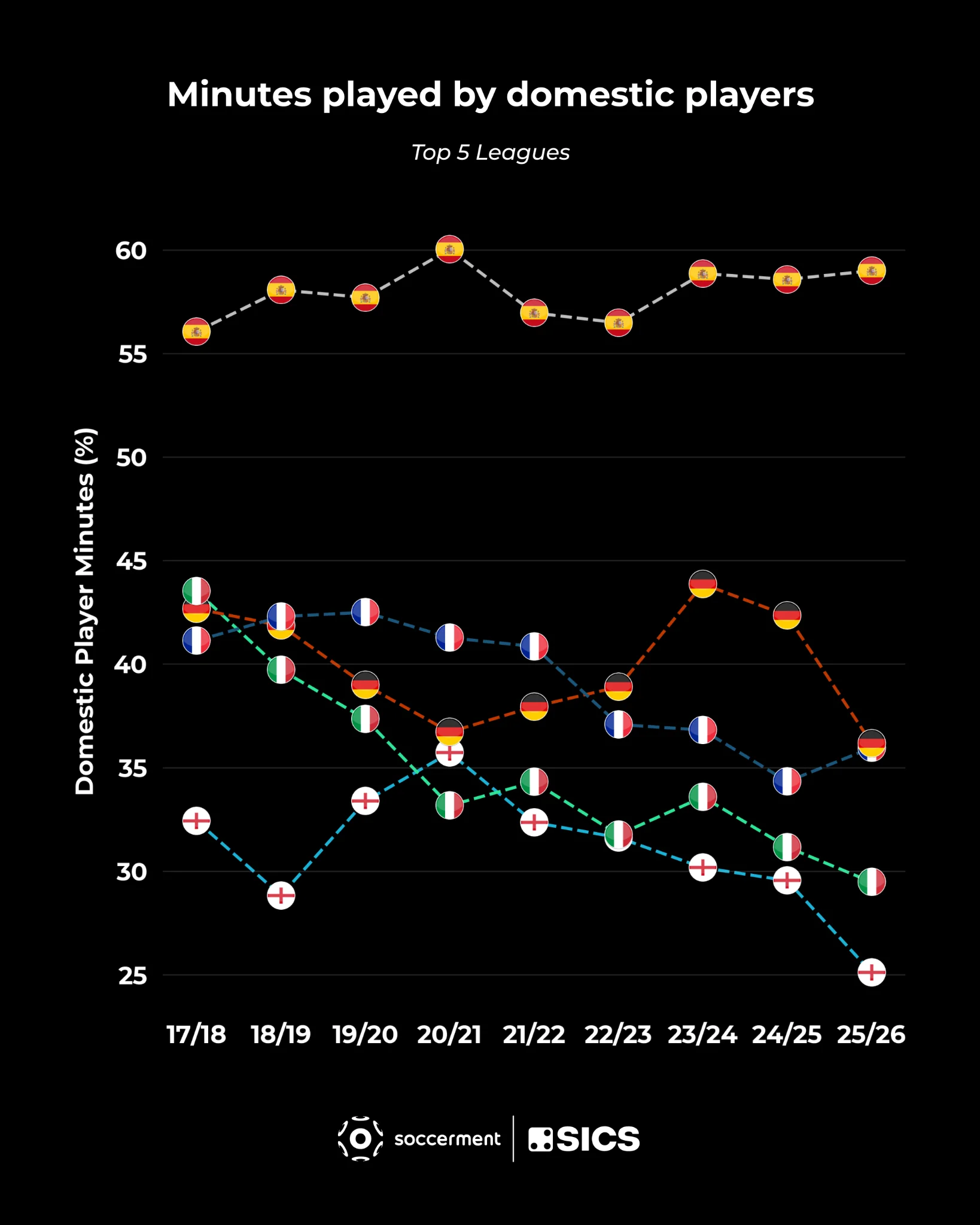
While there is no clear-cut direct link between domestic players' usage and national team performance level, this is a recurrent topic in the conversations surrounding the Italian national team. The percentage of minutes played by Italian players in Serie A has been in steady decline over the past nine seasons, dropping from 43.5% in 2017/18 to 29.5% in 2025/26 (Fig. 1). While this places Italy on the lower end of the scale for domestic player usage in the top 5 leagues, the Premier League has had an even lower value for all but one of the seasons considered. The real outlier in the group is La Liga, where Spanish players have consistently been getting between 55% and 60% of minutes across the past nine seasons, with no other league reaching above 45% in this time window.
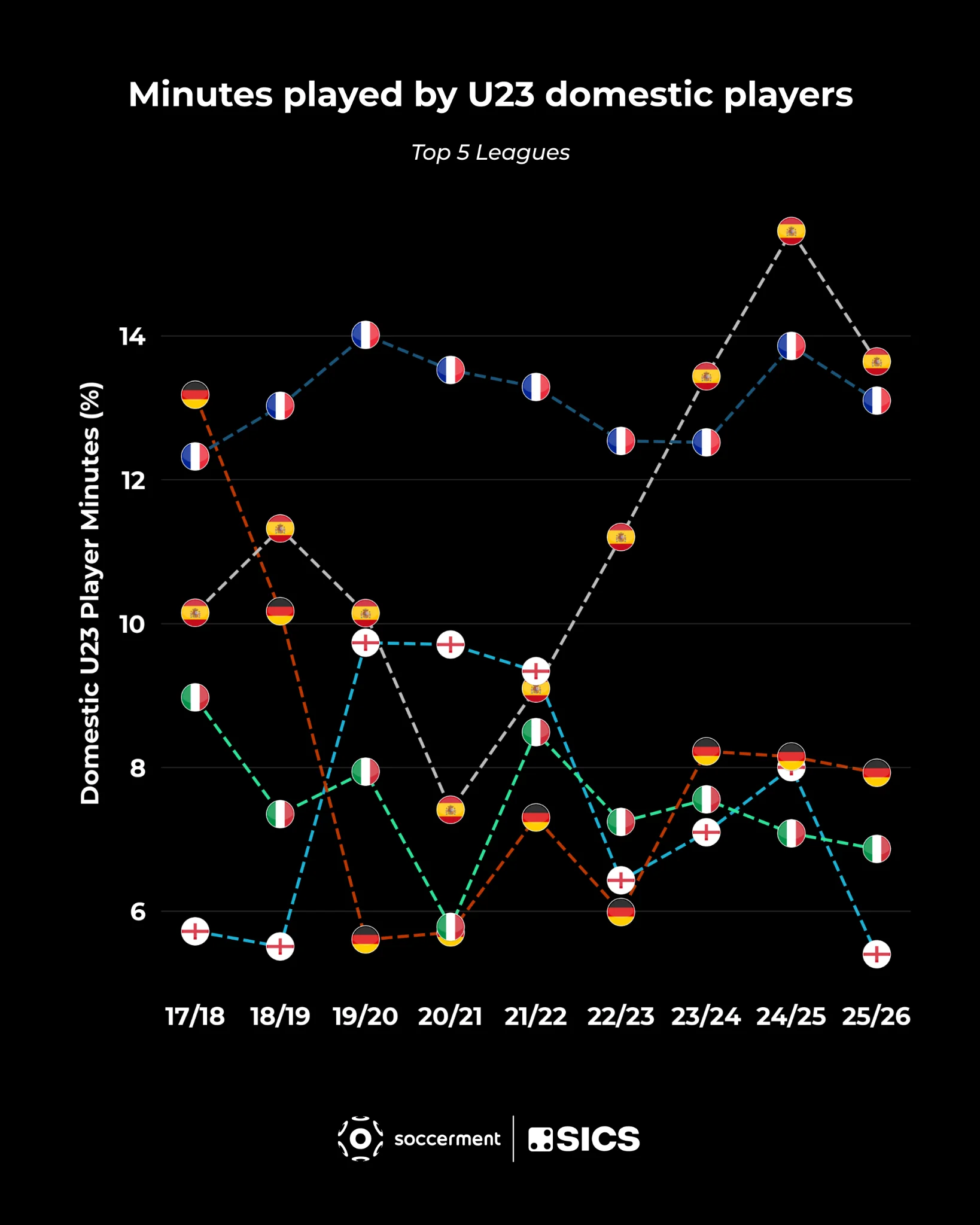
Another point of contention is the opportunities provided to young players. Serie A teams have a long history of giving few minutes to younger players on average, Italian or otherwise. This trend is confirmed when we look at the share of minutes played by domestic U23 players (Fig. 2), where Serie A has the second-lowest value among the top 5 leagues in 2025/26, only larger than the Premier League. This data point begins to show some link to national team performance: France has ranked significantly above the other leagues by this metric for most of the past nine seasons, and has recently been overtaken by Spain, thanks to the recent infusion of young Spanish talent becoming regular starters in La Liga teams, especially at Barcelona. France and Spain currently rank 1st and 2nd, respectively, in the FIFA national team rankings.
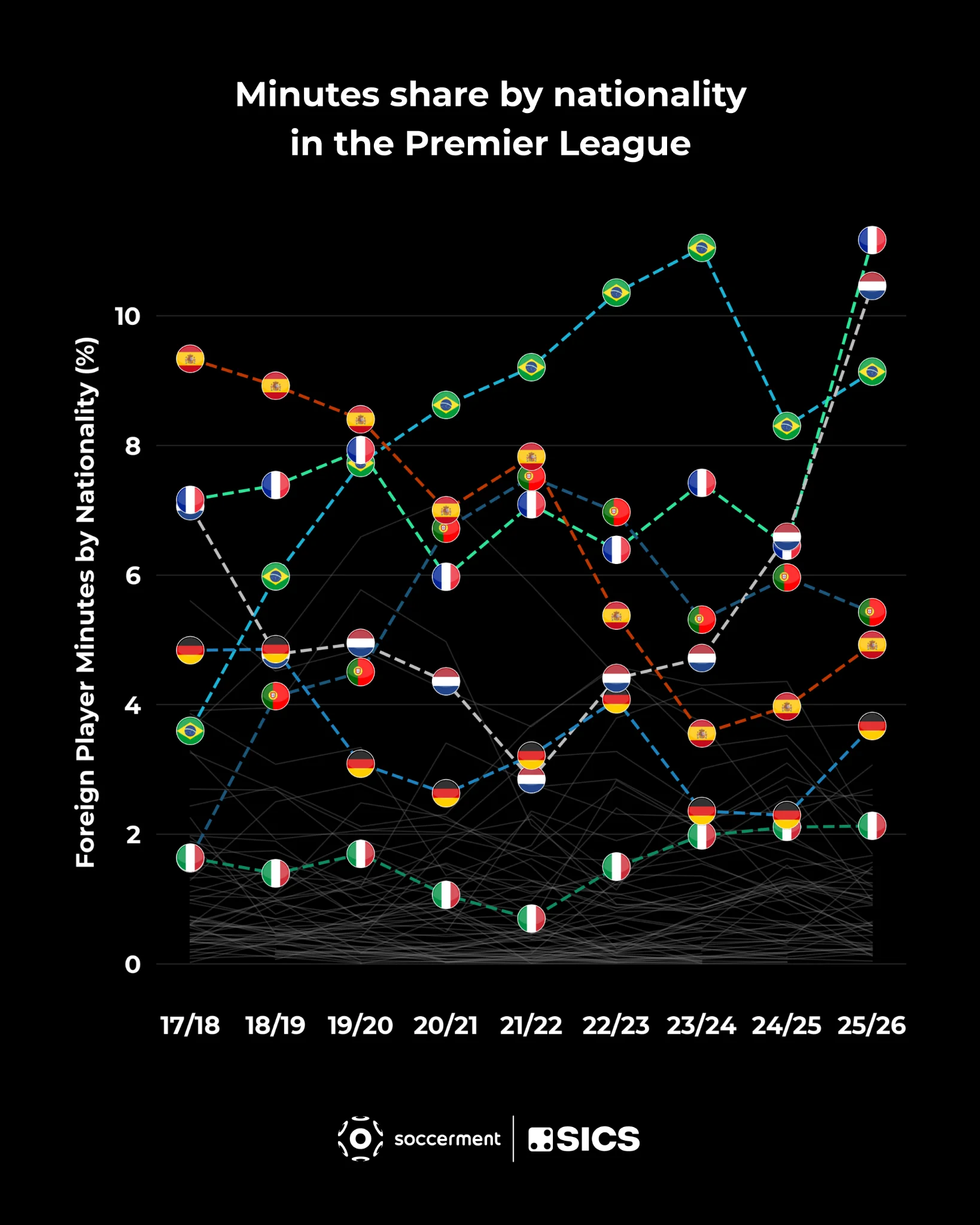
We can also look at Italian players’ usage in other leagues. The Premier League has established itself as a dominant force among European leagues thanks to a massive financial advantage, and is often able to recruit the best players on the transfer market. Therefore, examining the share of minutes for players of different nationalities in the Premier League might provide additional insights on this topic (Fig. 3). We can see that the Italian share of Premier League minutes is not among the largest, with France, Netherlands, and Brazil being the most represented nationalities.
The future of the Italian national team
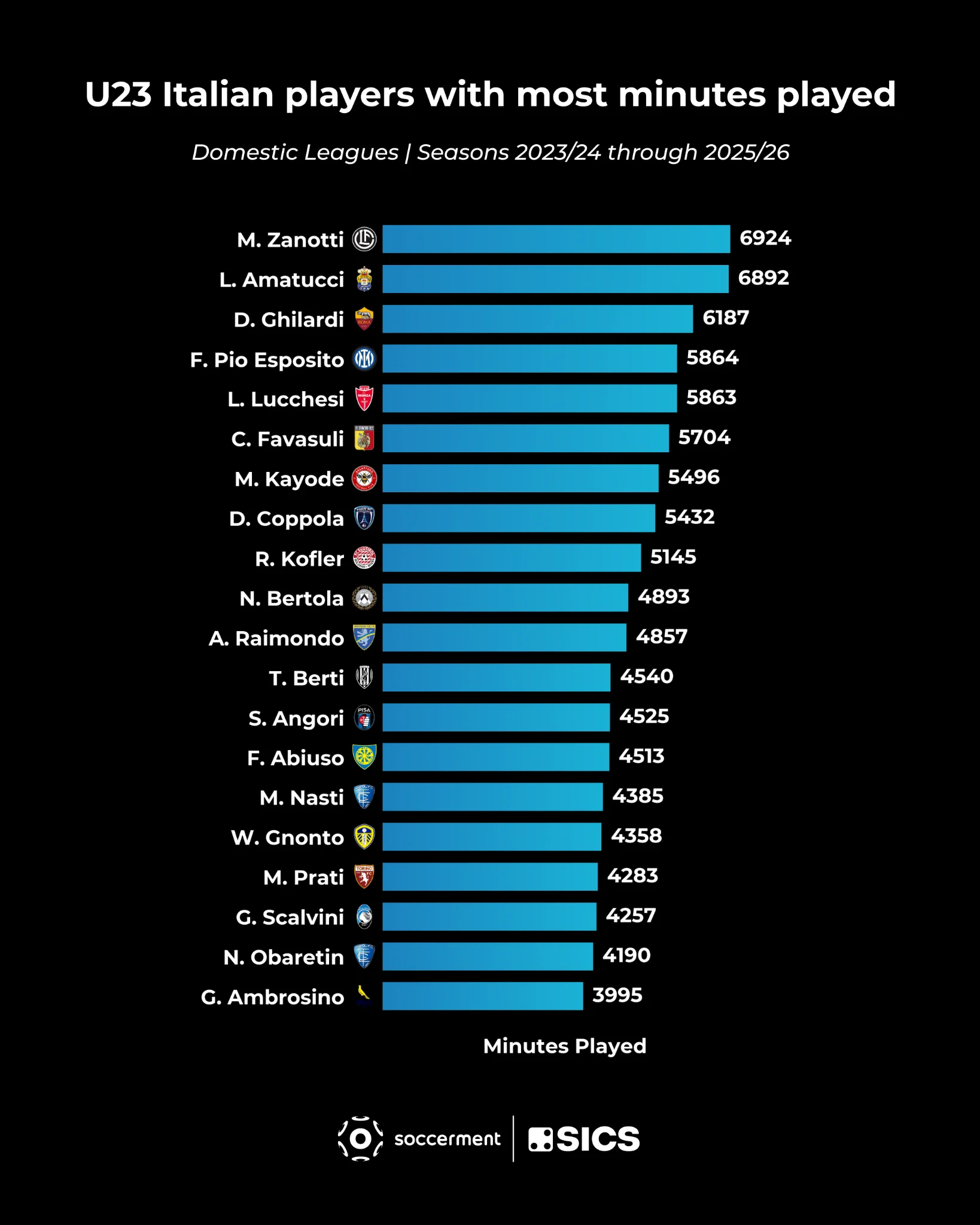
We looked into usage data for U23 Italian players to focus on a few names that might go on to create the backbone of the national team for the next World Cup attempt in four years. If we look at the 20 Italian players born after 1st January 2003 with the most minutes played in domestic leagues across the past three seasons, nine are currently playing in Italy’s second division, Serie B, six play in Serie A, and a few are developing abroad (Fig. 4).
We selected one defender, one midfielder, and one striker from this list that are either already on the national team’s radar or are likely to enter it in the near-medium term.
Defender: Giorgio Scalvini
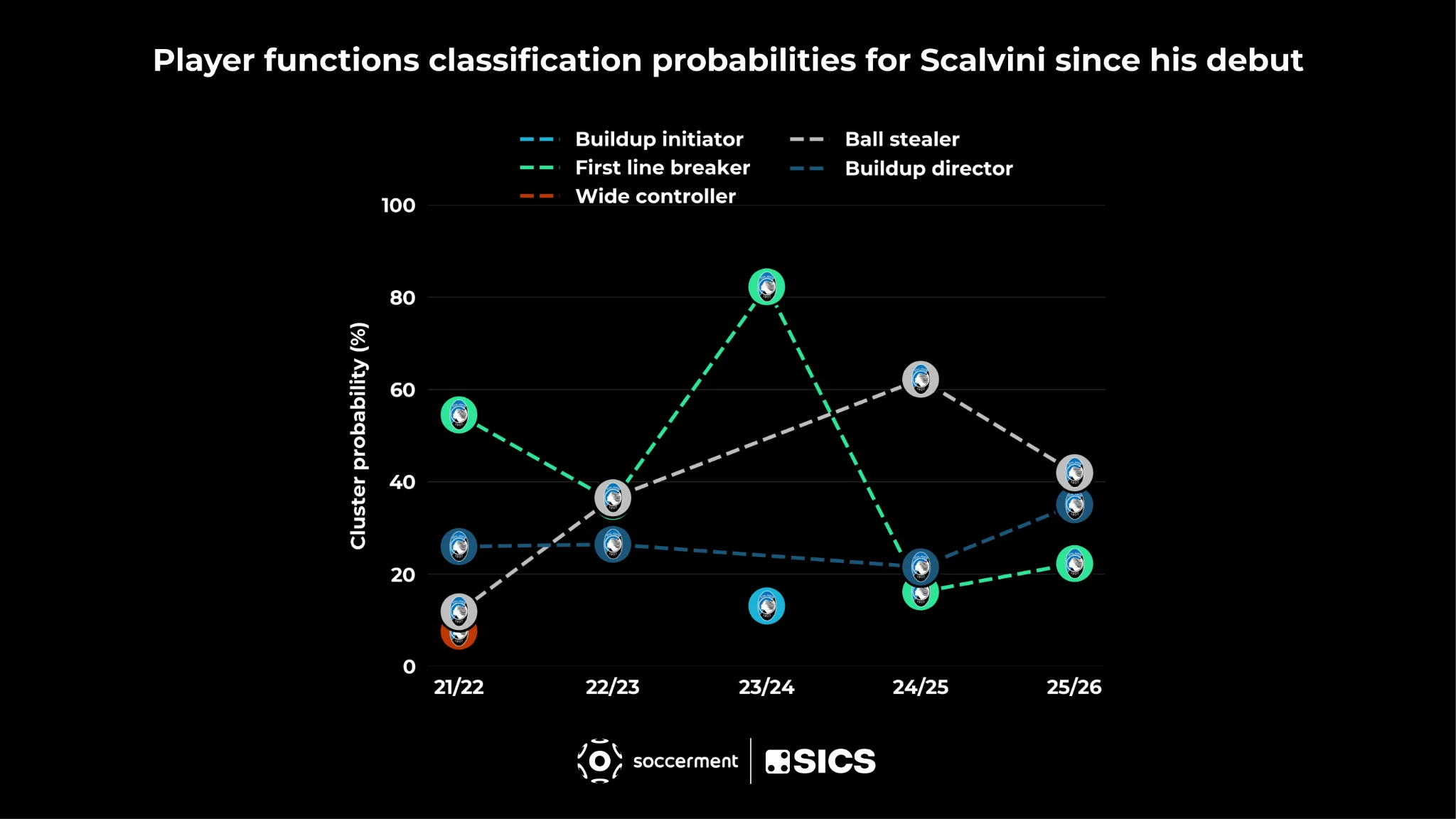
At 22 years old, Scalvini has been among the most interesting Italian prospects since making his debut at 17 and immediately becoming a significant contributor for Atalanta, with only numerous injuries limiting his playing time. Scalvini has mostly played as a wide center-back in a back three (either right or left), but has shown himself to be so competent on the ball that he’s often used as an extra midfielder in possession. In fact, our data-driven, position-agnostic player functions model sees him more as a deep lying midfielder (Ball stealer or Buildup director) than a center back in recent seasons.
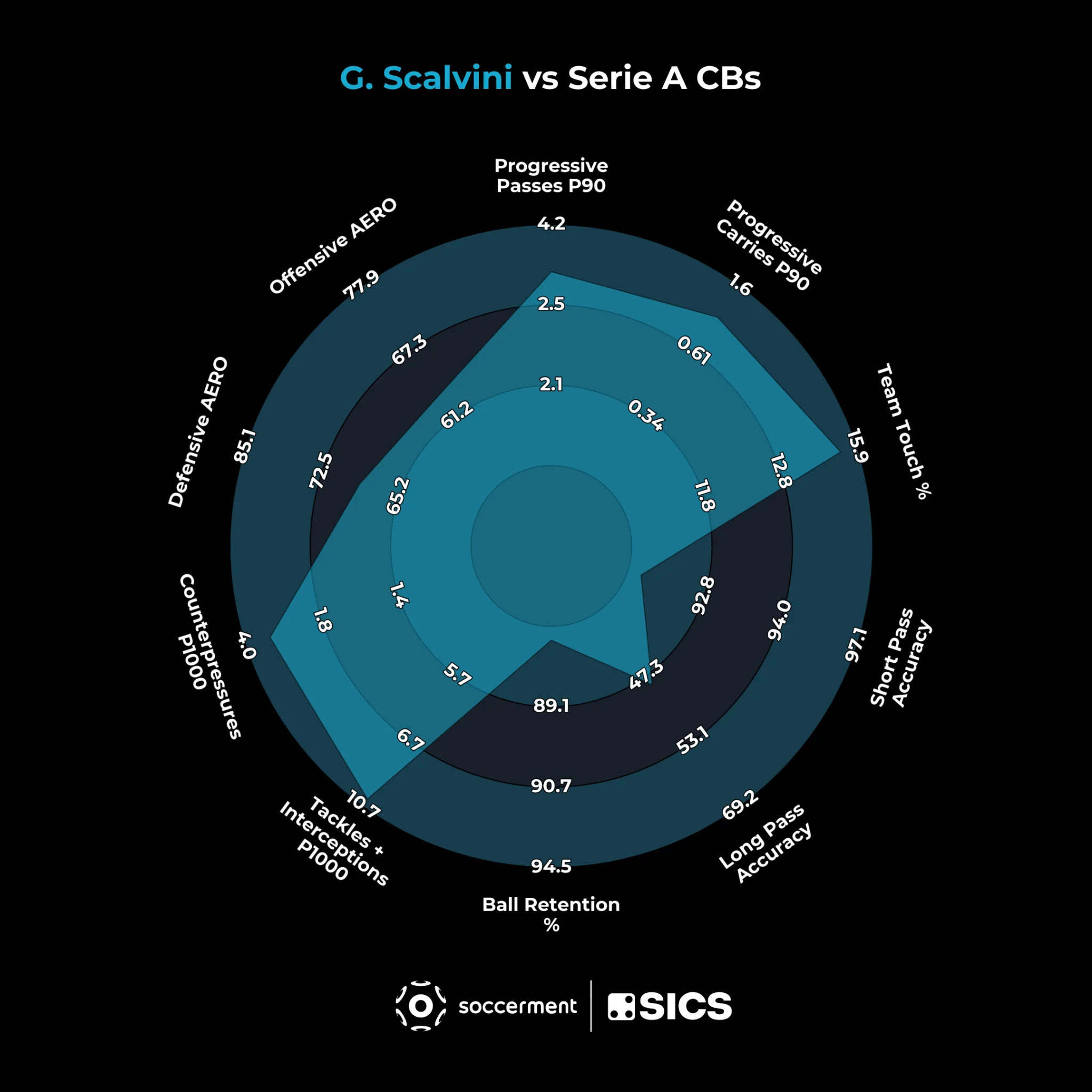
His stats reflect these characteristics, with Scalvini ranking very highly for ball progression (both via passes and carries) and involvement in possession (team touch %), while at the same time performing a very high volume of defensive actions and counterpressures. His low passing accuracy and ball retention can be at least partly explained by his proactive attitude in possession as revealed by his ball progression contribution, but certainly have room for improvement. His performance in aerial duels could also stand to be improved, especially considering his 1.94m height, which would likely require a stronger focus on physical strength training.
Midfielder: Lorenzo Amatucci
A Fiorentina academy graduate, Amatucci has already been on two loan spells in Serie B before moving on to a third loan at Las Palmas, in the Spanish second division, where he has established himself as a regular starter, playing 2,637 minutes across 32 games. The 22-year-old has always played as a classic regista, either as a central pivot in a three-man midfield or in a double pivot, with our player functions model classifying him as Buildup director with over 80% confidence.
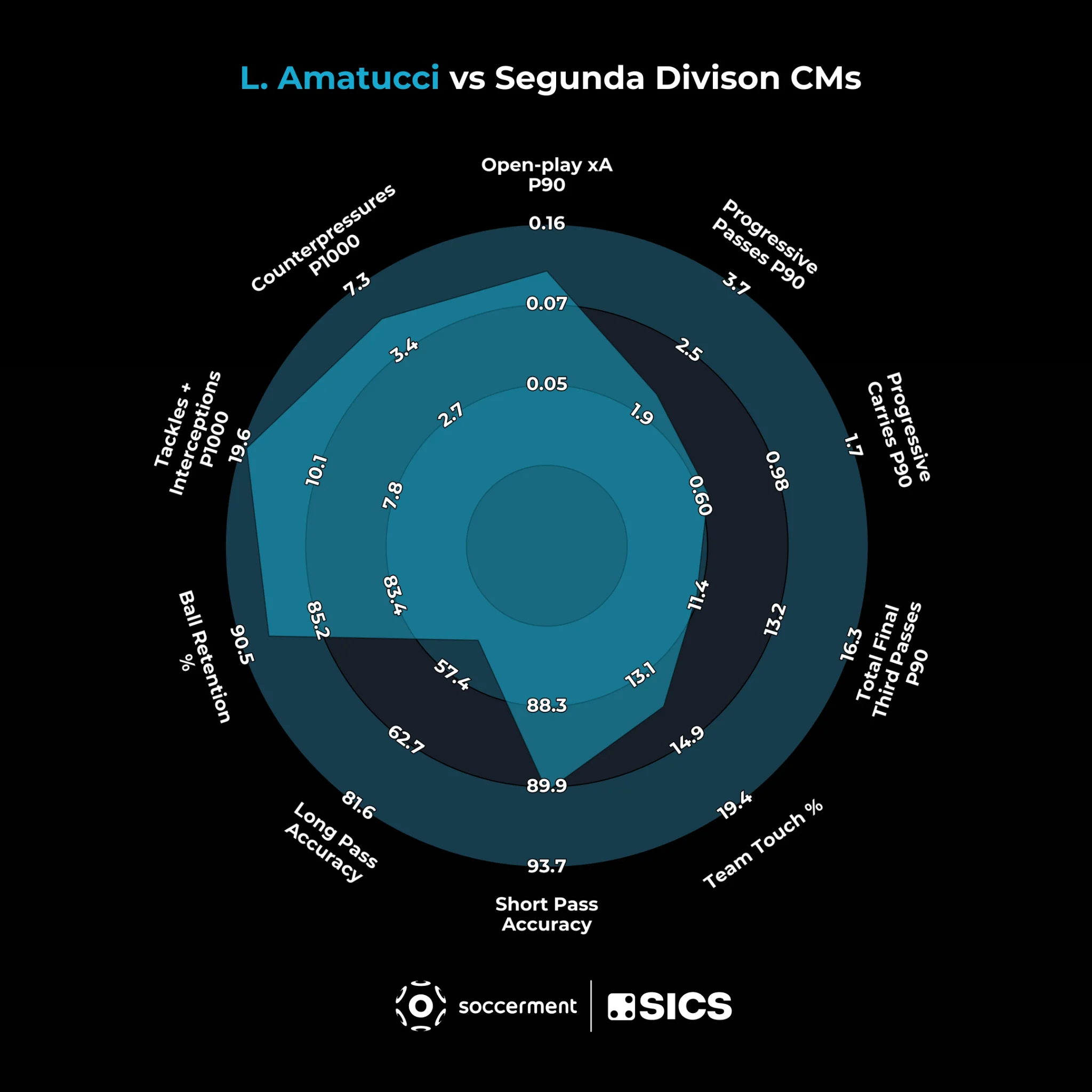
His stats for this season show a significantly above-average contribution to chance creation (open-play xA), with excellent short pass accuracy and ball retention, as well as defensive work rate. On the other hand, Amatucci ranks around average among Segunda division central midfielders for progressive actions and below average for long pass accuracy. This suggests his tendencies so far are mostly geared towards consolidating possession with safe passes, however, his good chance creation numbers suggest he has the ability to play more incisive passes in attacking areas. It will be interesting to see whether he will eventually get his chance at Fiorentina or if Las Palmas will exercise their option to make the transfer permanent.
Forward: Francesco Pio Esposito
Perhaps the most talked about prospect in this group is Inter’s Pio Esposito. After a breakout season in Serie B with Spezia where he contributed 17 goals and 2 assists, the 20-year-old has made his mark with the current table leaders, scoring 9 goals in 42 games across all competitions. Esposito is already breaking into the senior Italian national team, having scored 3 goals in 7 games.
Pio is the youngest of three footballer siblings. His older brother Salvatore (25) has now become a Serie B veteran, currently playing for Sampdoria as a central midfielder, while Sebastiano (23) has had many loan spells across Serie B and Serie A as a second striker or attacking midfielder and is currently a regular starter at Cagliari. In spite of his young age, Pio Esposito is a throwback to the classic #9. Our player functions model classifies him as Target man, a physically imposing center forward who functions as the focal point for the team’s attack and ball progression, contesting a high volume of aerial duels, often with his back to goal.
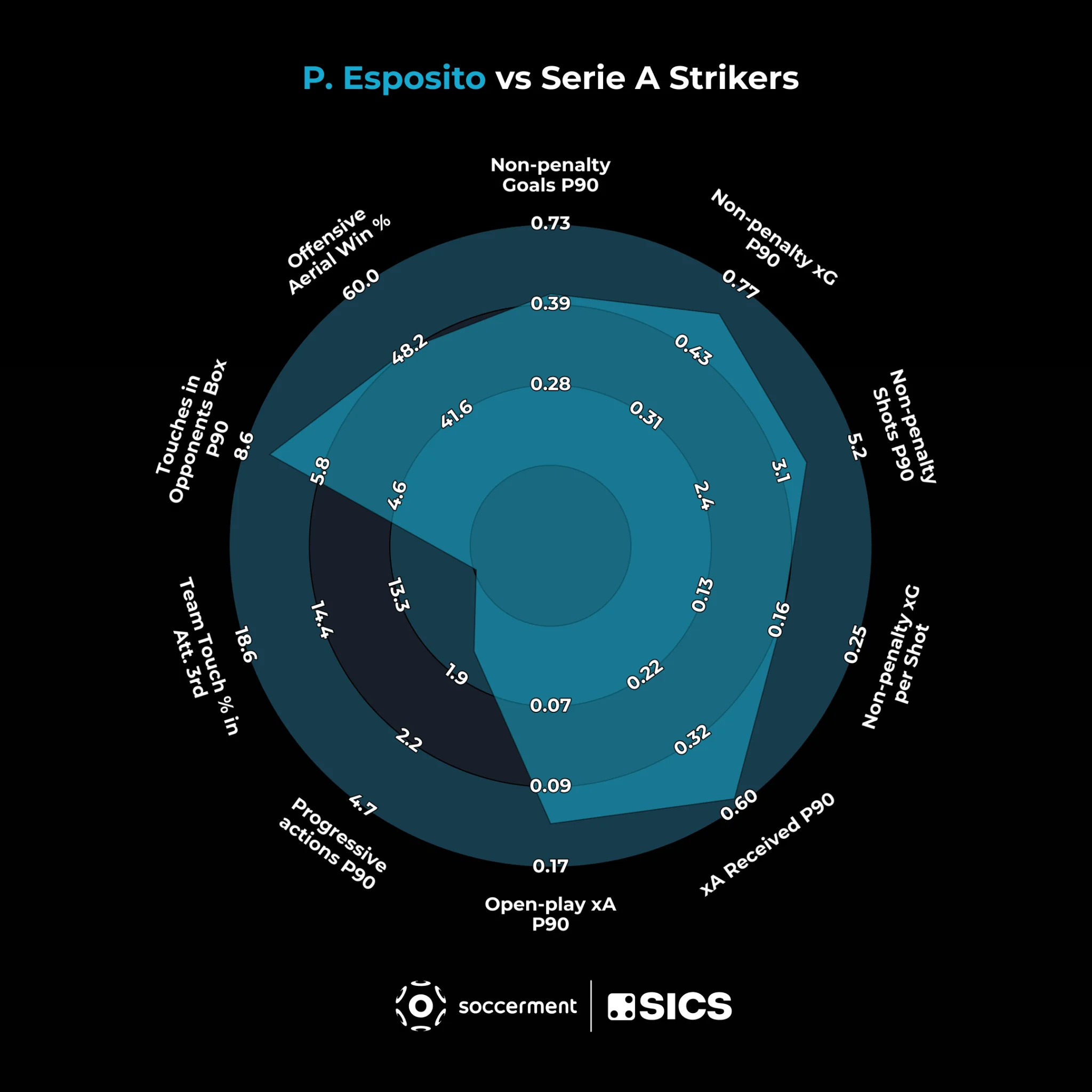
His stats have certainly benefited from playing in the best attack in Serie A. Esposito takes an above-average number of shots of good average quality (xG per shot), resulting in the 4th best rate of xG per 90 minutes among Serie A strikers. His finishing has clear room for improvement, with 26 goals scored from 32.9 xG across the past three seasons. His ability to act as a focal point for teammates is certified by his 2nd place for xA received and 4th place for touches in the opposition box. Finally, while he is not very involved in possession, as certified by below-average progressive actions and final third touch %, he provides a good chance creation contribution, with the 6th best open-play xA among Serie A strikers.
Conclusion: Structural Challenges and the Path Forward for Italian Football
The data presented underscores that Italy's consecutive failures to qualify for the World Cup are symptoms of deeper structural issues within Serie A. The primary challenge is the steady decline in domestic player usage, which has dropped to 29.5% of minutes played in 2025/26. Compounding this is the low share of minutes given to domestic U23 players, placing Serie A near the bottom of Europe's top five leagues. This reluctance to integrate young Italian talent stands in stark contrast to top-ranked nations like Spain and France, which show strong correlations between high youth usage and national team success.
Despite these systemic problems, there is a clear foundation of emerging talent, highlighted by prospects like defender Giorgio Scalvini, midfielder Lorenzo Amatucci, and forward Francesco Pio Esposito. These players exhibit the technical and statistical characteristics needed to anchor the national team in its next World Cup attempt. However, their potential can only be fully realized if Serie A clubs commit to reversing the current trends and prioritizing the development and integration of homegrown players into regular starting roles. The future success of the Italian national team depends on this required cultural and structural shift at the domestic level.