How open play is changing in the Premier League’s set piece meta
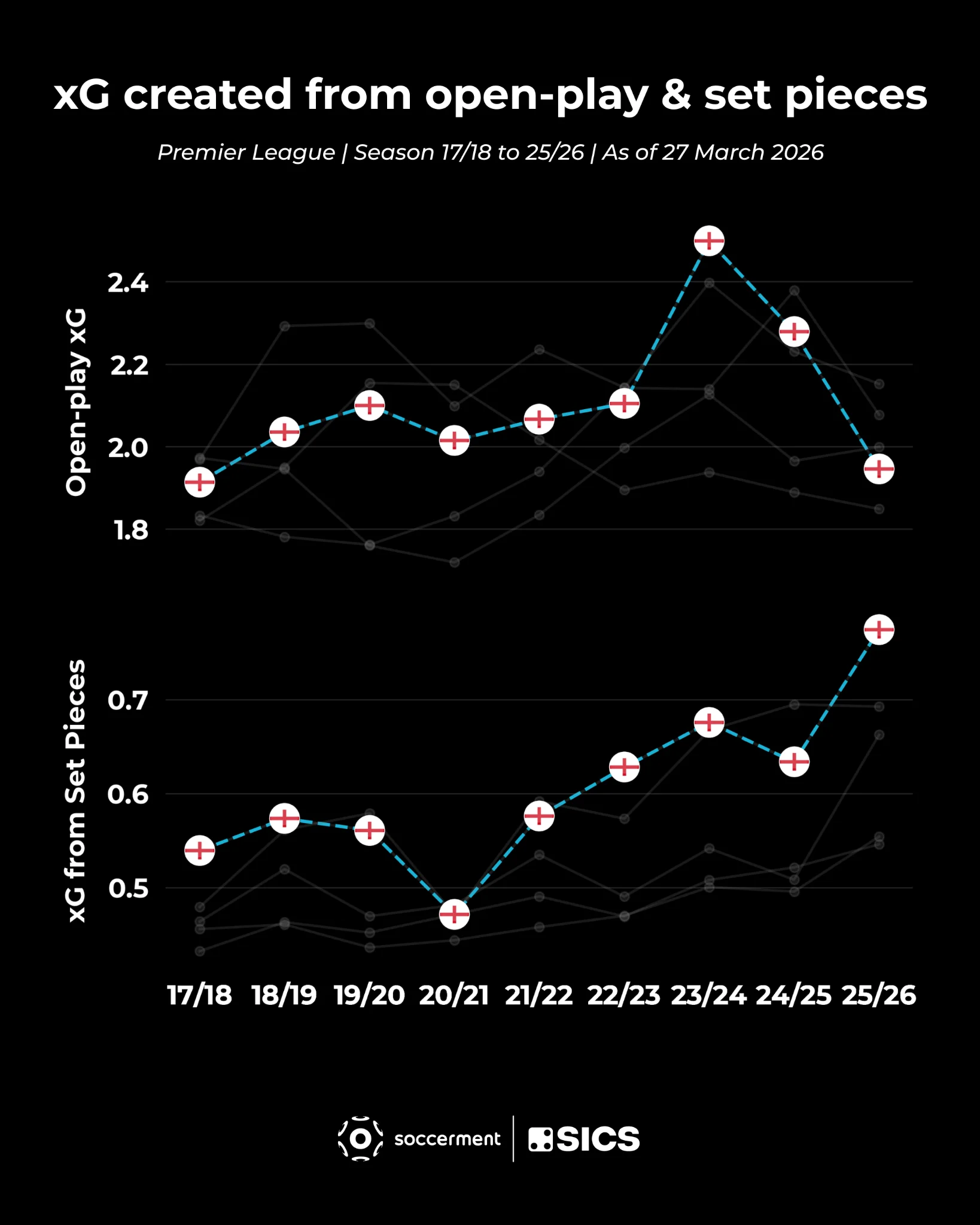
In the first edition of our newsletter, we focused on the explosion of attacking production from set pieces in the Premier League in 2025/26, and noted how it has coincided with a very significant drop in production from open play. In this analysis we will delve deeper into this topic, exploring how open play has changed in the Premier League.
First, let’s revisit the key data point: open play attacking production as measured by xG created per game is down to its lowest level since 2017/18, as shown in Fig. 1.
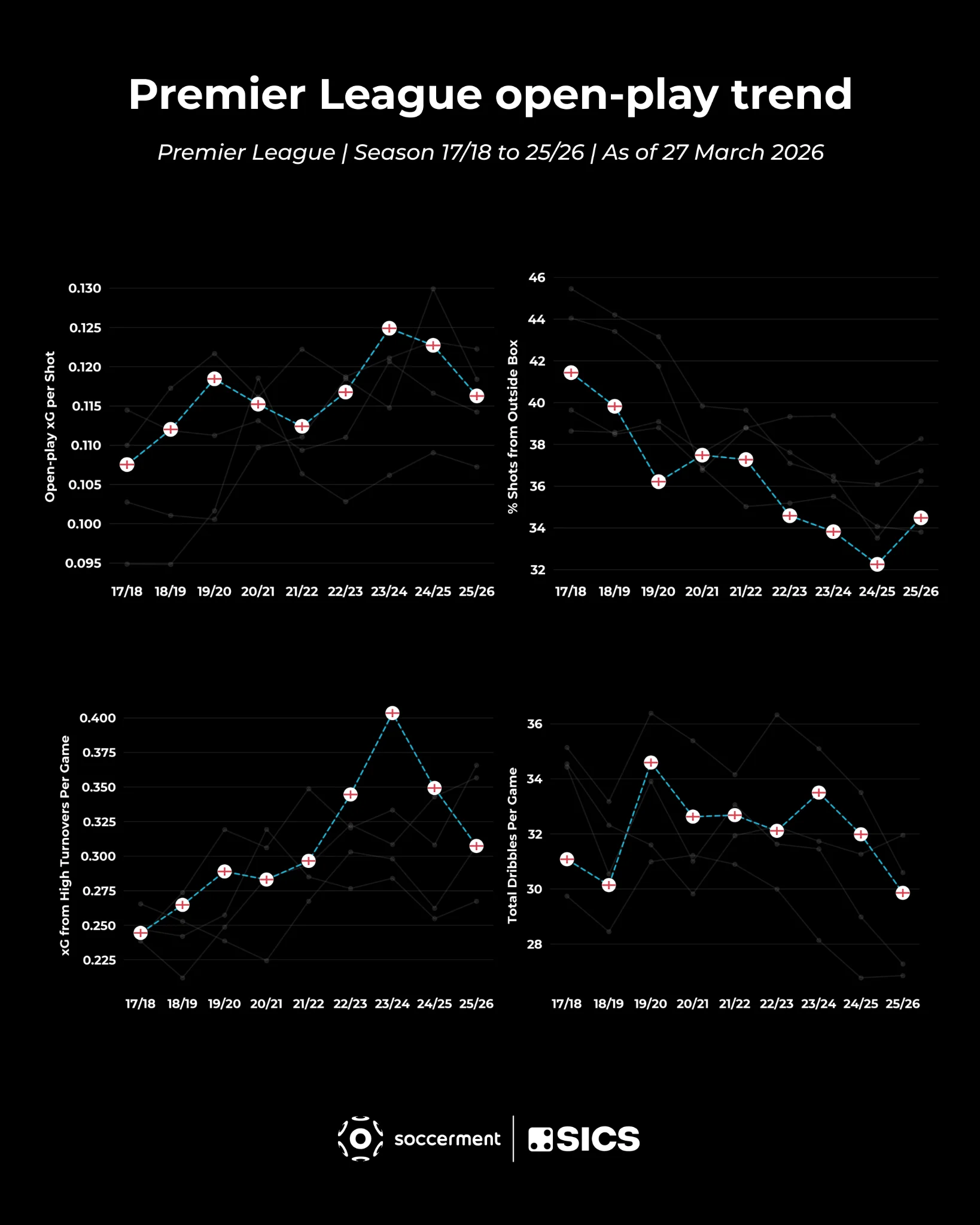
What else is changing in the way Premier League teams approach the game in open play? The average scoring probability for open play shots, measured by xG per shot, shows a significant decline after a period of sustained rise (interrupted by the seasons affected by Covid). This indicates that teams are struggling to create clear-cut chances in open play, which suggests a reduced appetite for risk-taking in open-play attacks, and/or a prevalence of more conservative defensive approaches with lower blocks. The latter is supported by data on the share of open play shots that are taken from outside the box. The current 2025/26 season is bucking a very steady long term trend across the top 5 leagues of fewer shots being taken from outside the box, a trend that the Premier League had been leading for most of the past nine seasons. This suggests that teams are struggling to break through lower defensive blocks and being forced to try their luck on low-probability shots from range more often.
As for the risk-taking aspect, there is also some evidence of teams being more conservative: xG produced by high turnovers, that is, sequences of play starting with a ball recovery in attacking areas, have been on a sharp decline in the past two seasons following a peak in 2023/24, and so have the total dribbles attempted per game. Both of these indicators point to a reduced appetite for risk taking, with teams being less aggressive and relying less on aggressively recovering the ball in attacking areas to create chances, while also being less willing to attempt high risk/high reward one v one duels which could lead to dangerous turnovers.
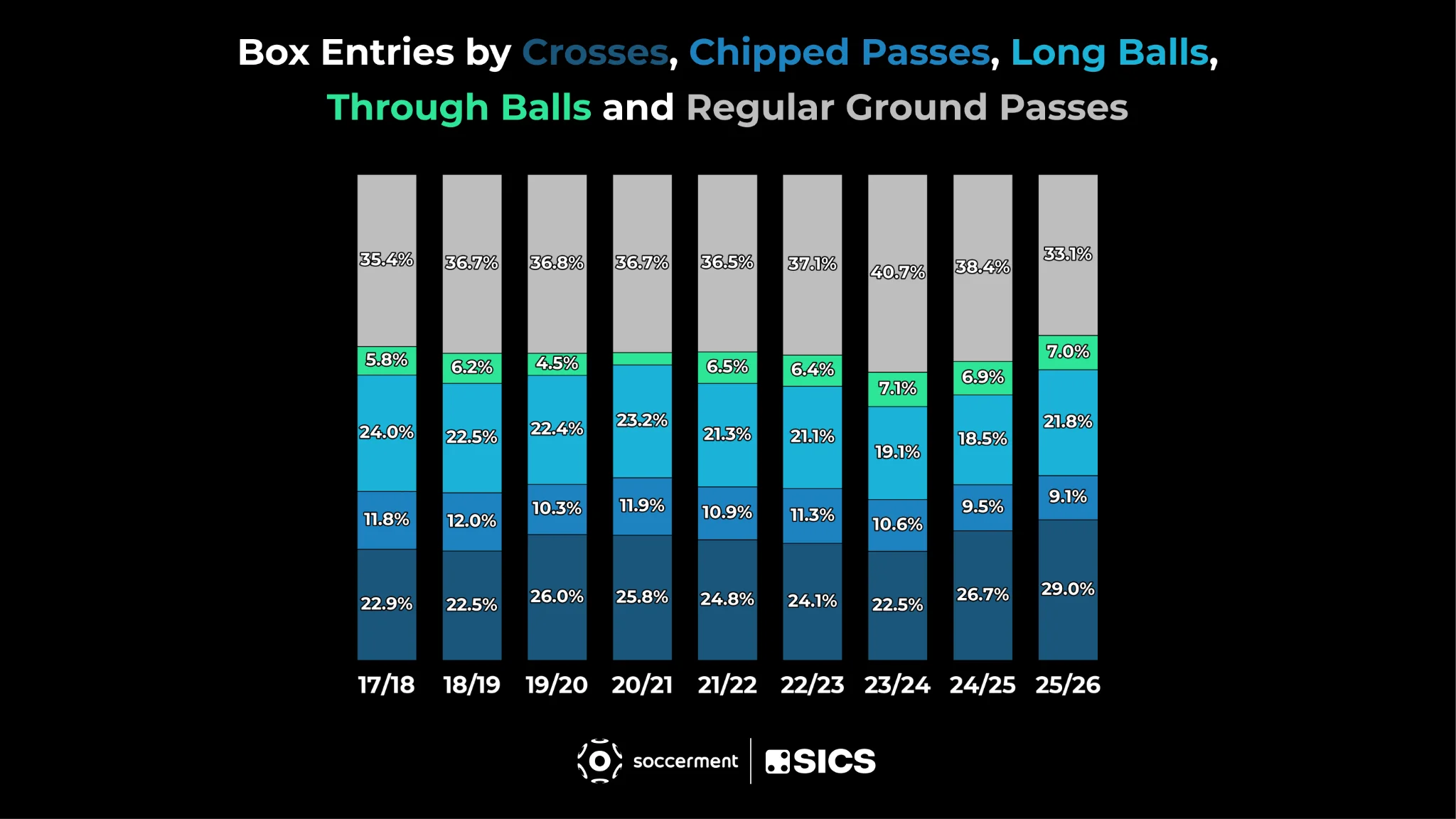
We can also see a shift in the ways teams pass the ball into the opposition box in open play. In the past two seasons there’s been an increase in the share of passes into the box coming from high or long passes, while ground passes (both regular and through balls) make up the lowest share of box entries seen in the last nine seasons. This reinforces the idea that teams are struggling to move the ball into good shooting positions with short passing combinations, resorting to bypassing the defensive block with high or long balls more often.
These tactical shifts are having an effect on how goal scoring is distributed among player positional groups as well. The share of non-penalty goals coming from attackers (center forwards and attacking wingers) is the lowest it’s been in the past nine seasons by a significant margin. This is consistent with the drop in open play attacking production in favor of rising production from set pieces, since midfielders and defenders can get more scoring chances from set pieces than in open play. This also means that expectations regarding goal scoring numbers from strikers should be adapted to the current context.
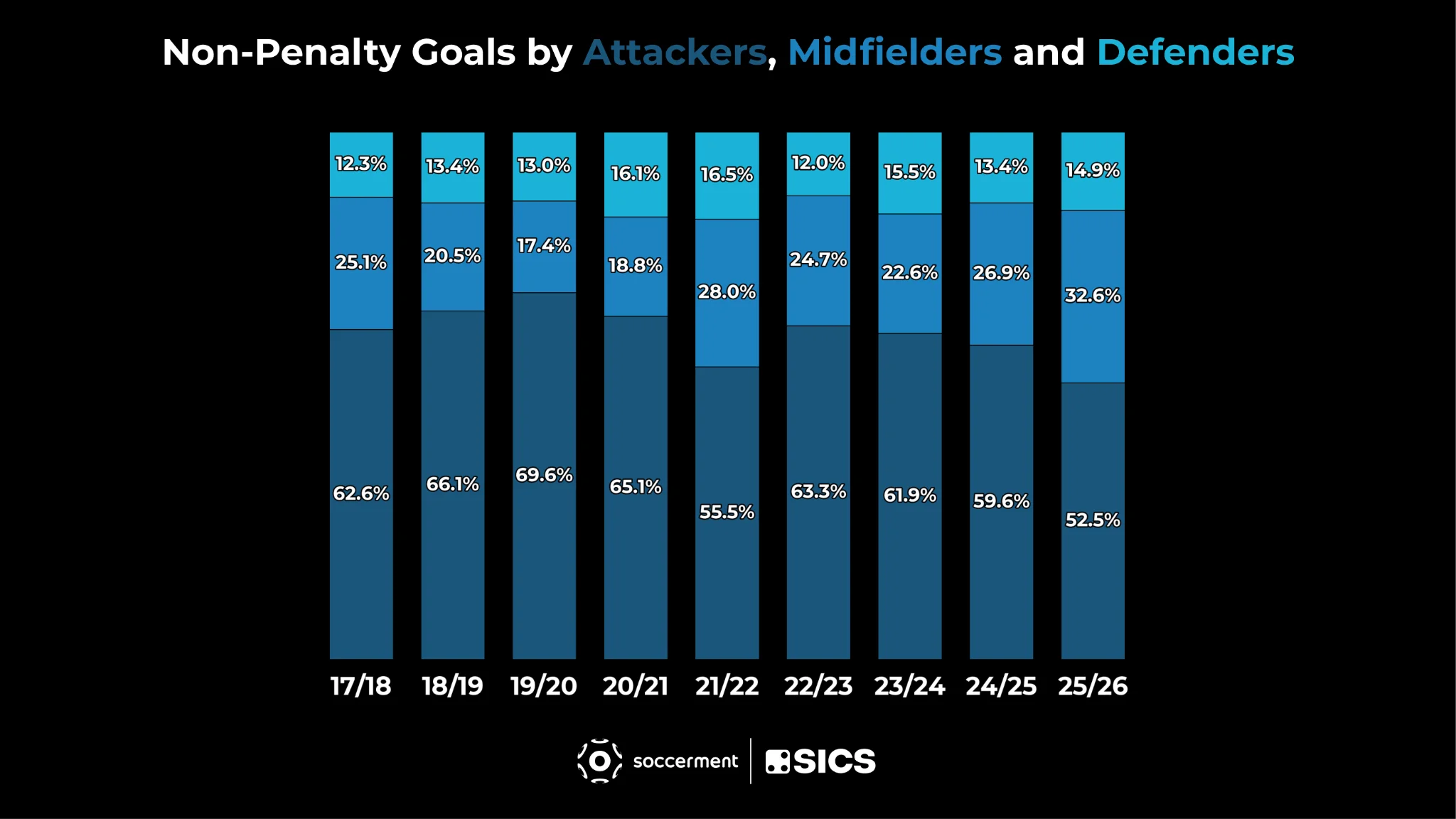
In summary, the recent evolution in the Premier League's tactical landscape has profoundly reshaped open play dynamics, driving open-play attacking production to its lowest level since 2017/18. This decline might be a consequence of a widespread shift toward conservative defensive approaches, characterized by lower blocks, and a reduced appetite for risk-taking in attack. Evidence for this includes a significant drop in the average scoring probability for open play shots (xG per shot), likely due to an uncharacteristic rise in shots taken from outside the box as teams struggle to penetrate defenses, as well as a sharp two-season decline in attacking production from aggressive ball recoveries in attacking areas and dribbling attempts. Furthermore, teams are increasingly bypassing defensive blocks by resorting to high or long passes into the opposition box, with ground passes now accounting for the lowest share of box entries in nine seasons. This tactical environment is having a direct effect on player production: the share of non-penalty goals scored by attackers (center forwards and attacking wingers) is the lowest it has been in the past nine seasons. As goal production is increasingly sourced from set pieces, expectations for traditional striker goal-scoring numbers must be adapted to this new, more conservative tactical context.