Serie A's Defensive Identity: Strength or Liability?
The context
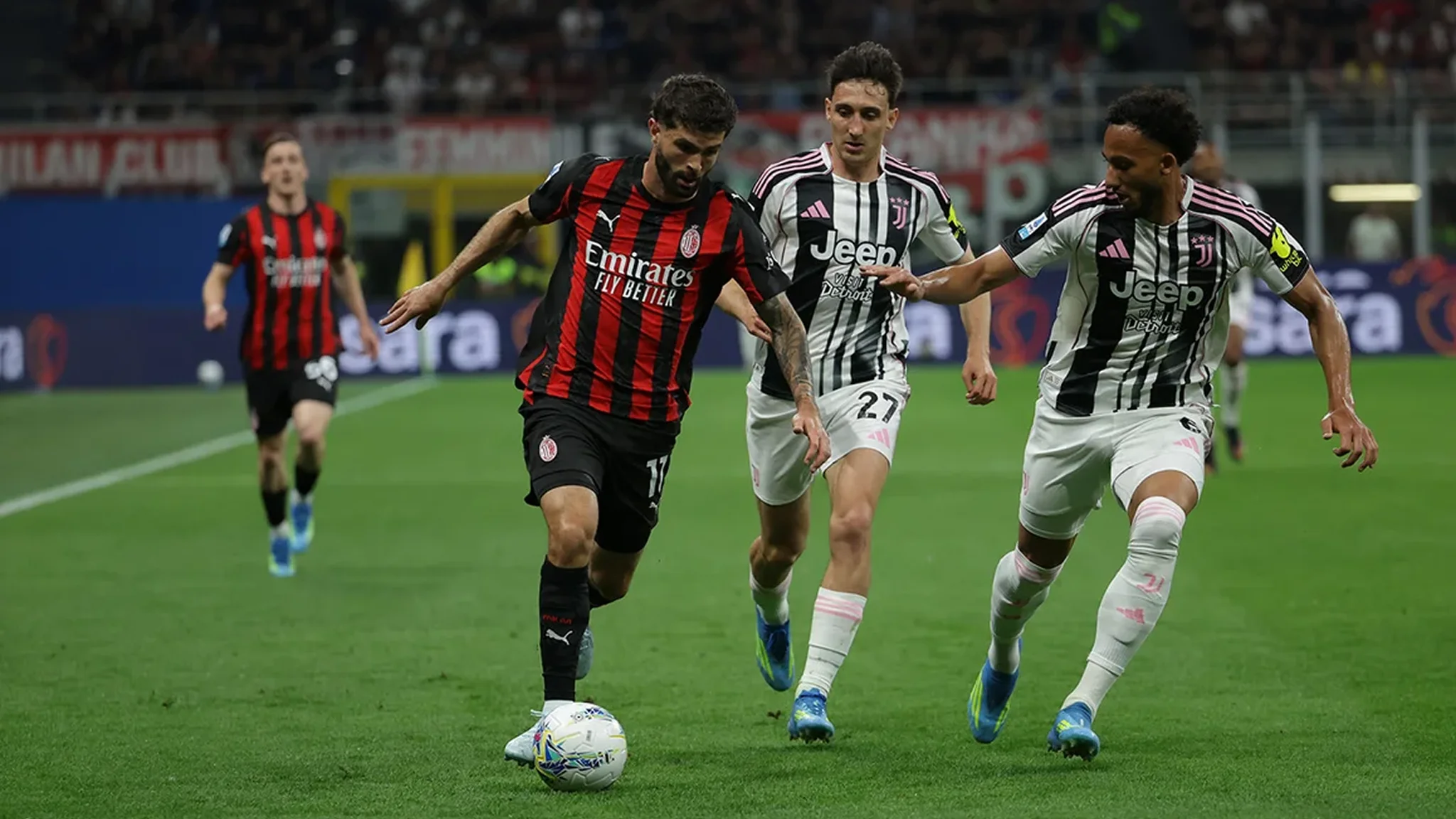
For those of us who follow Italian football closely, the debate has become hard to ignore. Italy's failure to qualify for a third consecutive World Cup reopened a conversation that never really closed: what is happening to Italian football, and why does the gap with the rest of Europe seem to be growing? In a previous edition of this newsletter, we looked at some of the structural factors behind that question, examining the decline in domestic player minutes in Serie A and profiling a generation of young Italian players who may yet shape the national team's next cycle. The question took on a sharper edge recently when Milan hosted Juventus at San Siro on 26 April in one of the season's most anticipated fixtures, a match that finished 0-0 and left most observers underwhelmed. Two days later, PSG and Bayern Munich played out a 5-4 Champions League semi-final first leg that was widely described as one of the best European ties in years. The contrast was difficult to miss.
Our starting point for this analysis was that contrast. Rather than adding to the volume of opinion, we wanted to look at what the data actually shows: whether the current criticism reflects a genuine, measurable trend or whether recent results are being read as more significant than they are. What we found is that the numbers do tell a story, and it has been building for several seasons.
The trend
Italian teams have long been associated with a defensive style of play, focused more on avoiding conceding goals than on scoring them. This season in particular, the average number of goals has been significantly lower than in other top European leagues: Serie A is currently at 2.41 goals per match, compared to 2.70 in La Liga and as high as 3.22 in the Bundesliga.
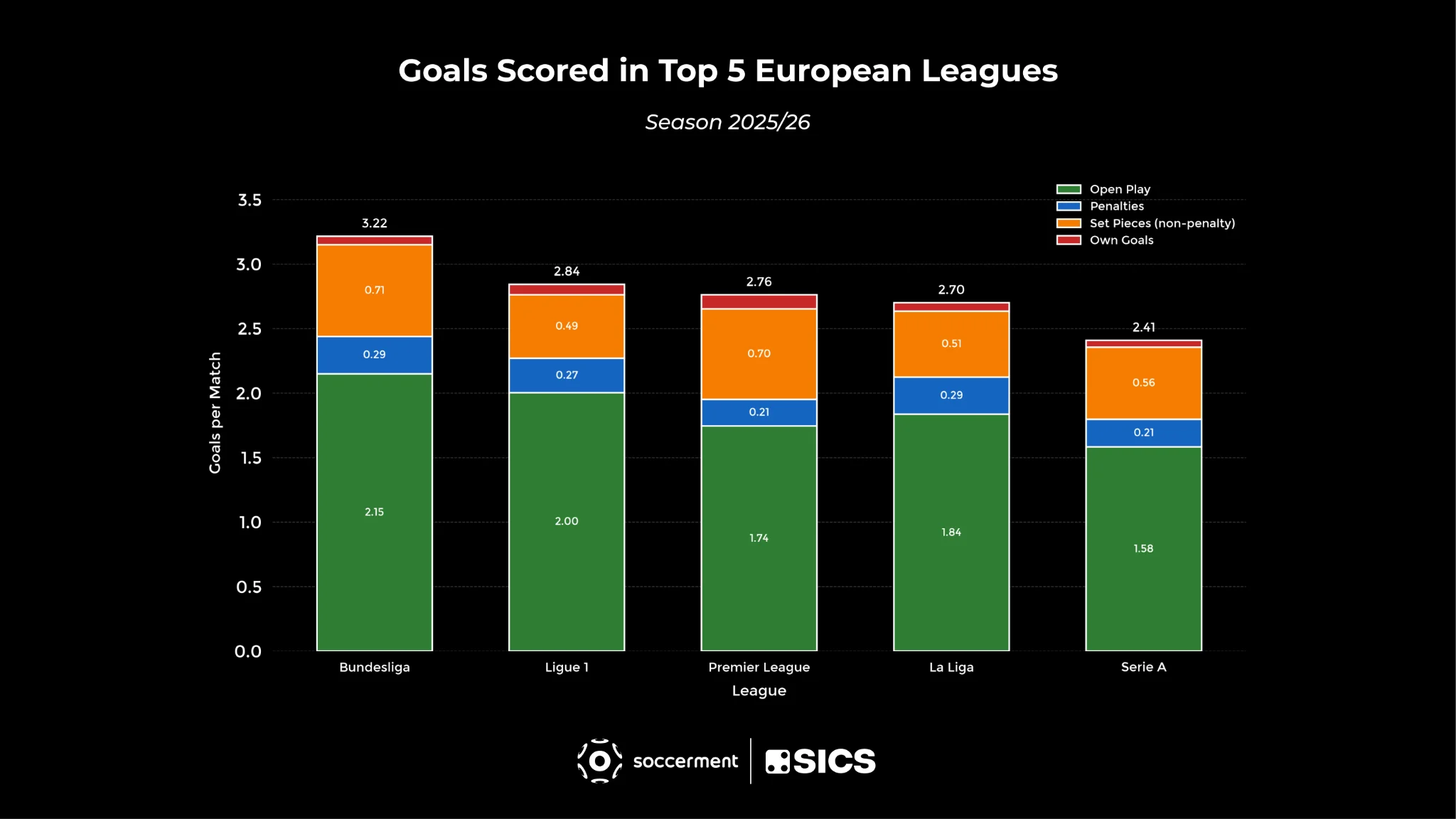
The main gap comes from open-play goals, where Serie A records 1.58 per match against 2.15 in the Bundesliga and 1.84 in La Liga. Penalties and set piece goals are largely in line with the other leagues. This reflects a broader tactical tendency: Italian teams are generally more cautious, prioritizing defensive solidity and limiting the risks that could expose them to counterattacks.
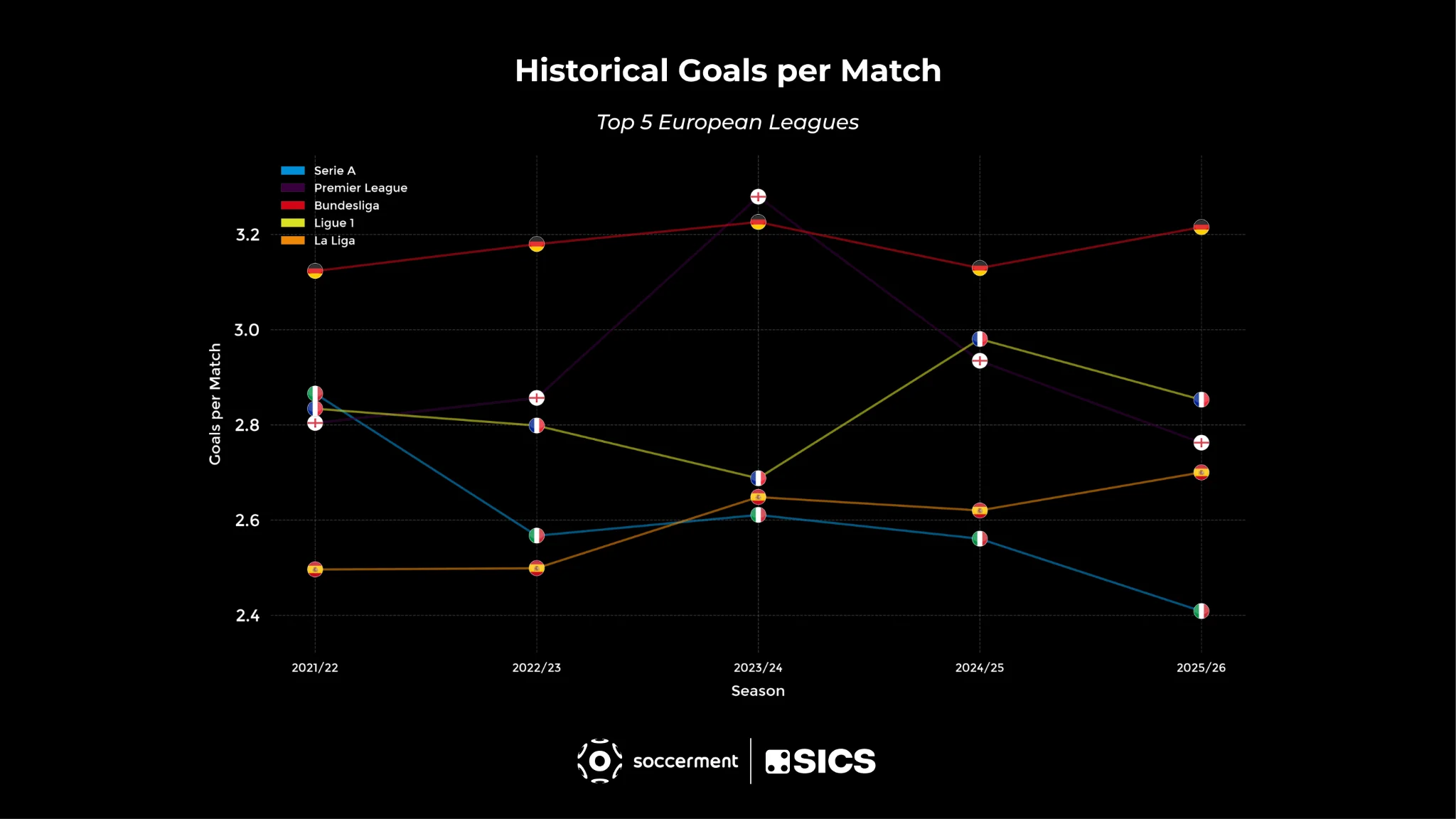
This is not a new phenomenon. Looking at the past five seasons, Serie A has followed a consistently downward trajectory, from around 2.85 goals per match in 2021/22 to the current 2.41. The other major leagues have fluctuated over the same period, but without a comparable directional trend. La Liga, which in 2021/22 was the lowest-scoring league among the top five, has since recovered ground. Serie A has moved in the opposite direction, and the gap has widened.
The 0-0 problem
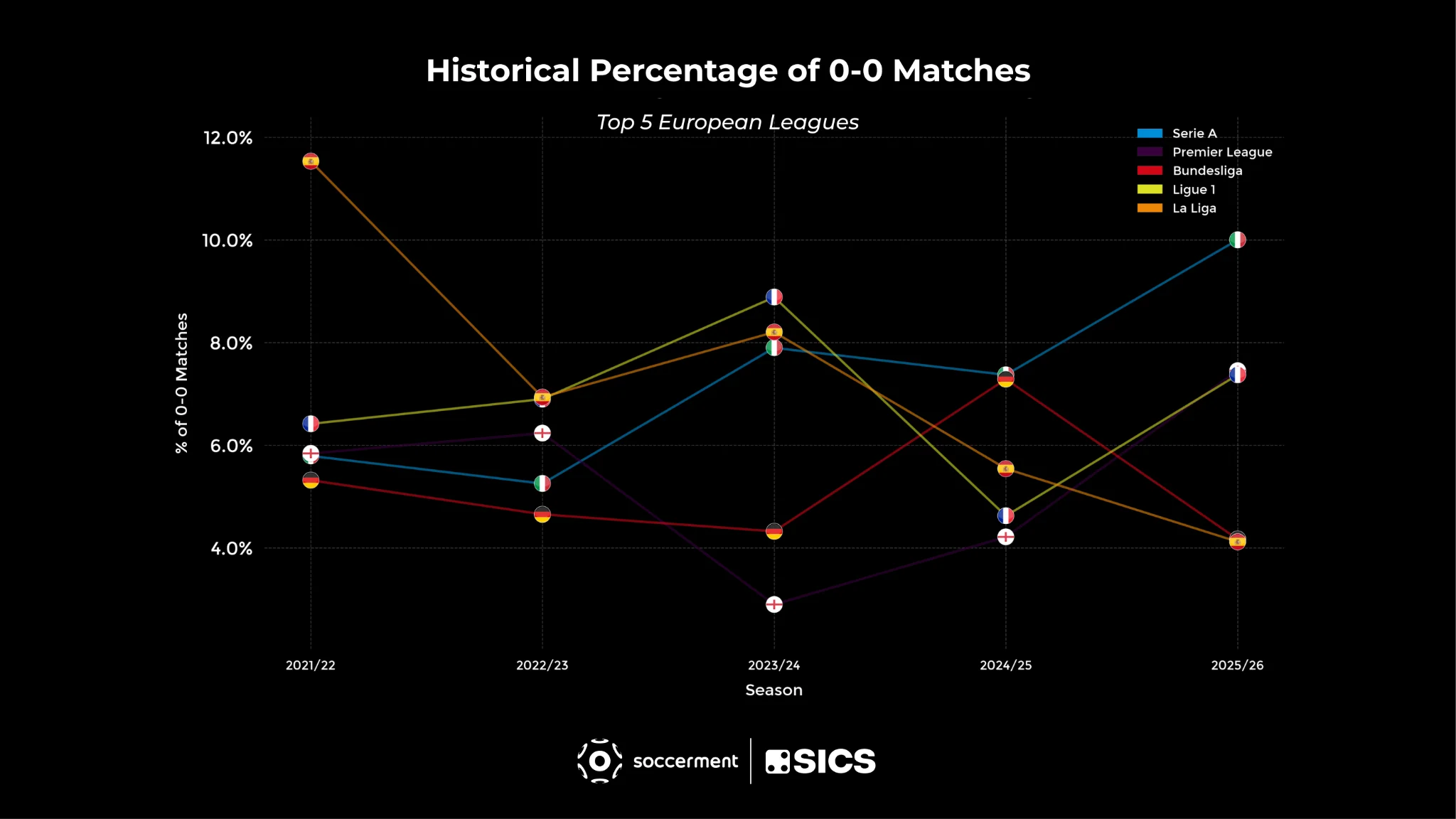
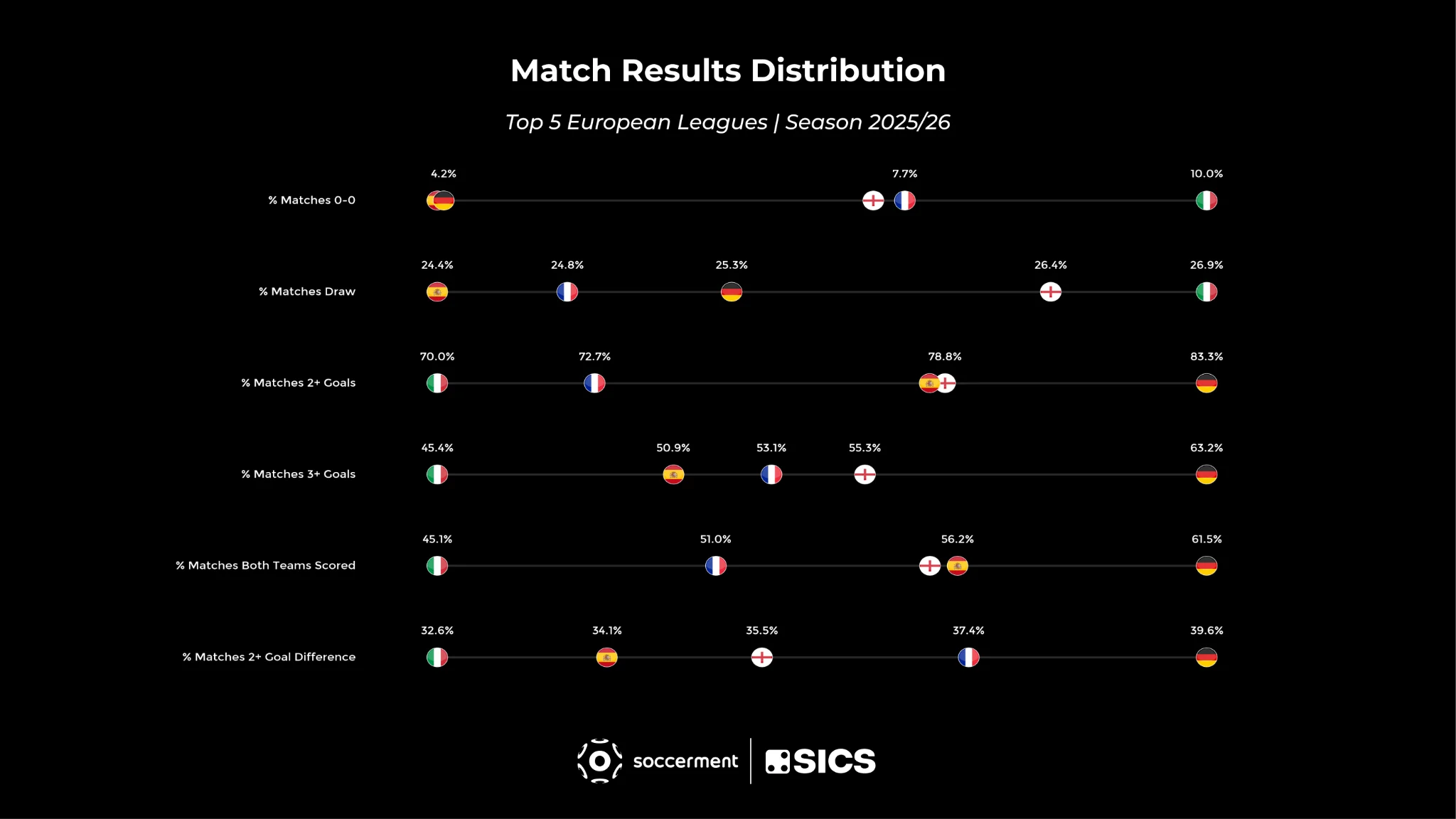
The same pattern appears when looking at 0-0 results. In 2021/22, the percentage of goalless draws in Serie A was broadly in line with the other major leagues, around 5%. Since then it has risen steadily, reaching 10% in 2025/26, the highest figure among the top five. Over the same period, the Bundesliga has fallen to 4.2% and the Premier League to 4.3%. A result that was once a statistical outlier has become a recurring feature of the Italian season.
The broader distribution of results tells the same story. Serie A has the lowest percentage of matches producing two or more goals (70.0%, against 83.3% in the Bundesliga), the lowest share of matches with three or more goals (45.4% against 63.2%), and the lowest percentage of matches where both teams score (45.1% against 61.5% in the Bundesliga). Matches decided by two or more goals are also the least common in Serie A, at 32.6% against 39.6% in the Bundesliga. Even when there is a clear gap in quality, heavier wins are relatively rare: weaker sides tend to defend deep and limit the margin, while evenly matched teams often settle for a point that suits both in the table.
What the data shows
To understand where the low scoring comes from, it helps to separate the contributing factors: how many chances are being created, how well those chances are converted, and how much goalkeepers are influencing the outcome.
xG, or Expected Goals, measures the probability of a shot resulting in a goal based on factors such as shot location, body part used, and type of assist. xGoT, or Expected Goals on Target, focuses instead on shot placement within the goal frame, assigning a value only to attempts that are on target and weighting them by how difficult they are to save.
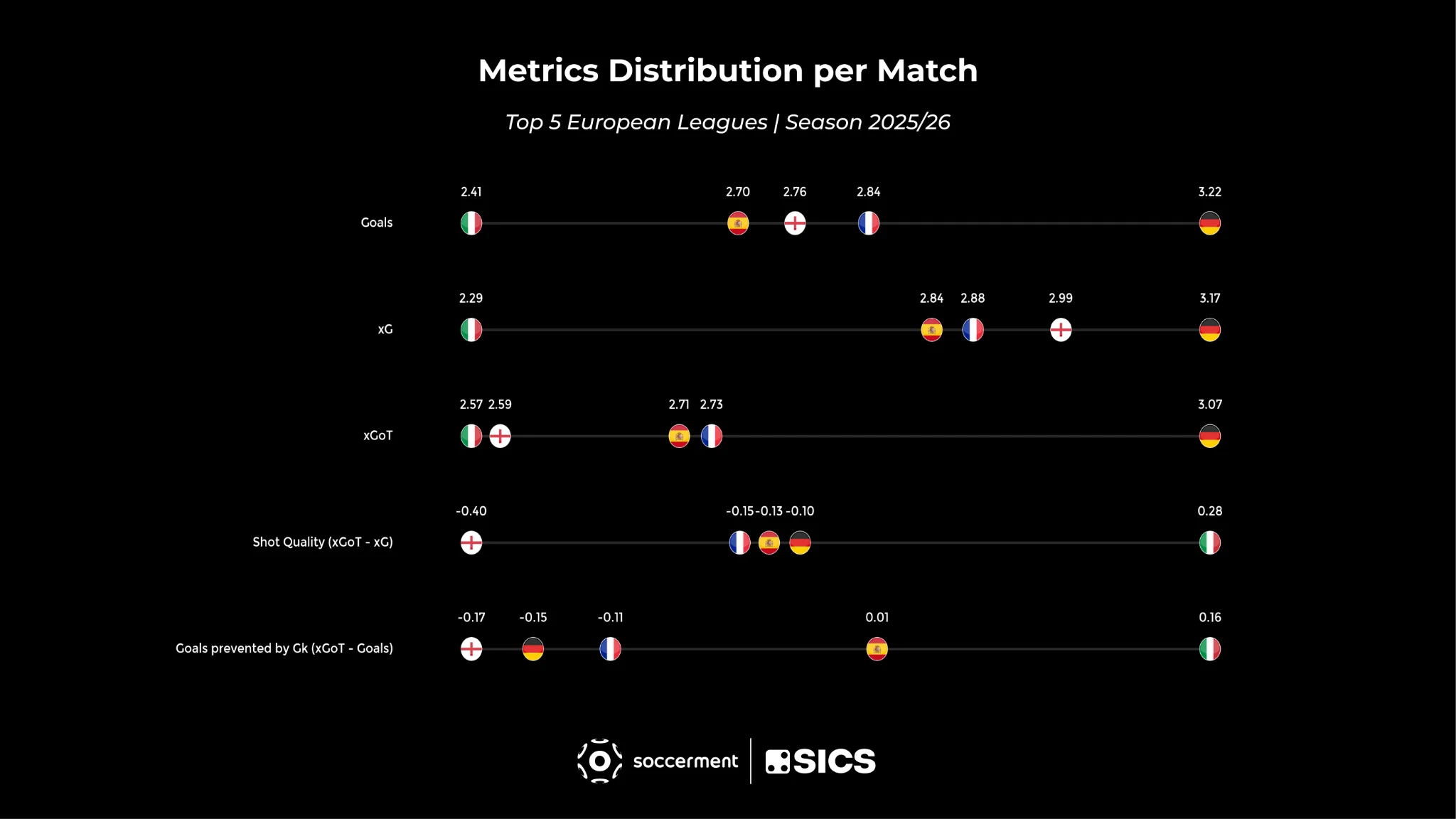
Even by xG, Serie A ranks last among the top five at 2.29, with the gap to other leagues actually wider than the raw goal difference suggests. What the data also shows is that, despite scoring less than most, Italian teams slightly exceed their xG (2.41 goals scored against 2.29 expected). Attackers, in other words, are not the problem.
The xGoT picture adds another layer. Serie A still ranks last in overall xGoT at 2.57, but the values are much closer to the other leagues than the xG comparison suggests. More notably, Italian teams rank first in shot quality, measured as the difference between xGoT and xG, at +0.28. When chances do fall, the attempts tend to be more dangerous, placed in positions that are harder to save.
That finding connects directly to goalkeeping. Measuring the difference between the goals a goalkeeper would be expected to concede based on shot placement and the goals actually conceded, Serie A goalkeepers prevent an average of 0.16 goals per match, the highest figure among the top five. That translates, roughly, to one goal per six matches absorbed by goalkeeper performance rather than allowed through. In the Premier League, Bundesliga and Ligue 1, the equivalent figure is negative: goalkeepers are conceding more than the shots would predict.
The picture that emerges is not one of a single cause. Serie A teams create fewer open-play chances than their European counterparts, and that gap has grown over five seasons. When chances do arise, they tend to be high-quality, but they are consistently met by strong goalkeeping. The result is a league where the margins are narrow, the rhythm is controlled, and goals, when they come, are rarely the product of open, attacking play.
A structural question
Italian football has historically been built on defensive solidity. For much of the late twentieth century and into the early 2000s, that identity was also a source of genuine competitive strength: Italian clubs were regulars in the latter stages of European competition, and the national team was a consistent presence at major tournaments. The tactical discipline that made Serie A difficult to score in also made Italian sides difficult to beat on the continental stage.
The question the data raises is whether that same orientation has become a liability in a football landscape that has shifted. European football has moved toward more aggressive, higher-scoring approaches, and the results at both club and national level suggest Italian football has not moved with it. Three consecutive World Cup absences are one measure of that. The relative scarcity of Italian clubs in the deep stages of recent European competitions is another.
Whether this reflects a structural resistance to change, a coaching culture that still prizes defensive organization above all else, or something more specific to how Italian clubs are built and managed, is beyond what the numbers alone can tell us. What the data does suggest is that the frustration in the current debate is not misplaced. The trend is real, it has been building for several years, and a single high-profile 0-0 did not create it.