The Ballon d'Or 2026 snubs: Doué, Raphinha and Enzo Fernández through the lens of xValue
Every shortlist leaves someone out. We ran the 2025/26 season through xValue, Soccerment's new event-value metric, to test the three biggest omissions of the 70th Ballon d'Or.
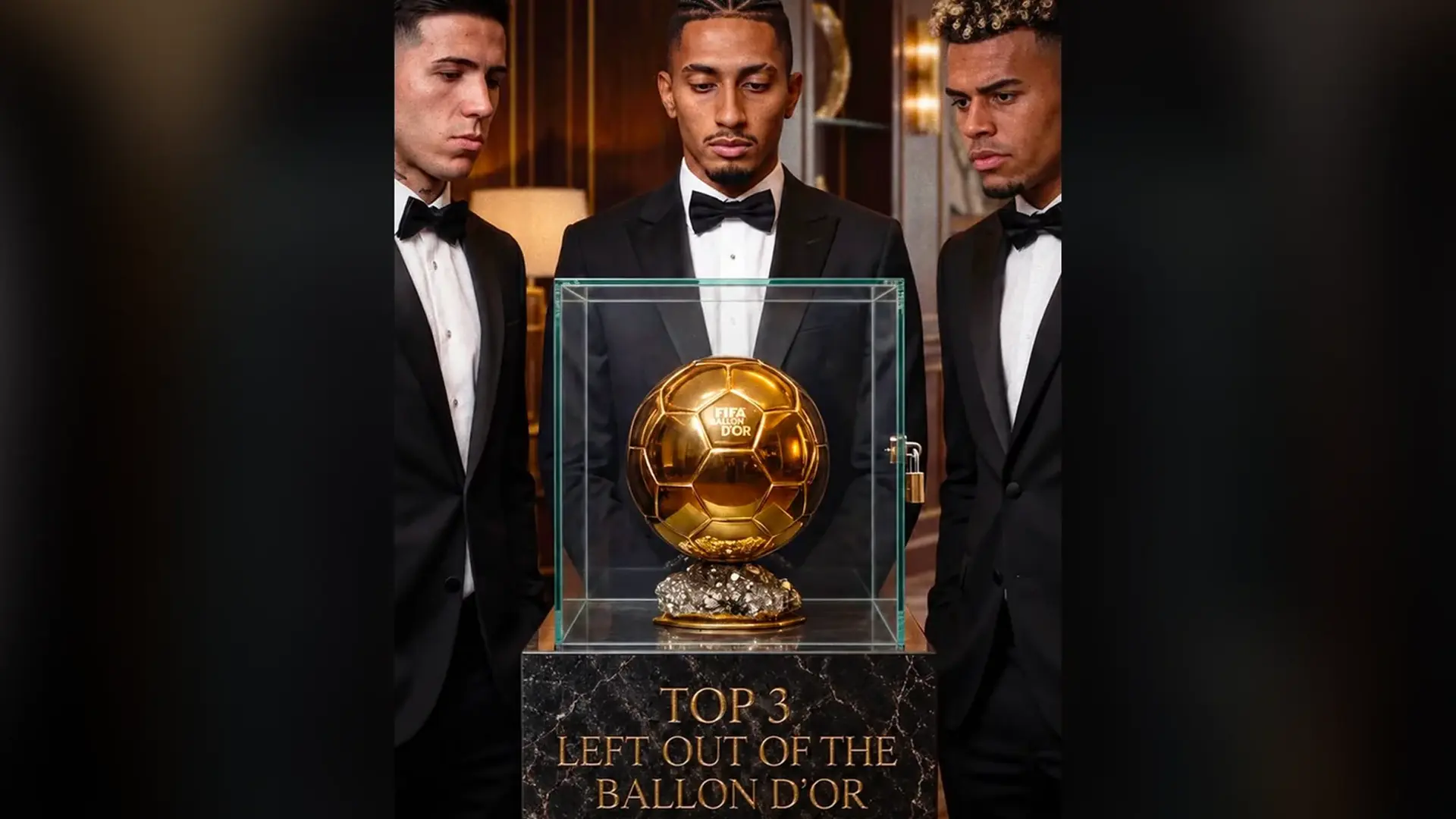
Every Ballon d'Or shortlist leaves someone out. For the 70th edition, Soccerment Research looked at the data for and against the three biggest names who did not make the 30: Désiré Doué, Raphinha and Enzo Fernández. The analysis was first published with Fabrizio Romano on 26 October 2026, ahead of the ceremony.
The sample covers the 2025/26 season in Europe's top five leagues, the Champions League and the 2026 World Cup: 2,683 players. Rankings per 90 minutes only include the 1,109 players with at least 1,800 minutes.
What is xValue?
xValue is Soccerment's new event-value metric. At any moment of a match, the team in possession has a chance of scoring in the next 30 seconds and a chance of conceding: the difference is the value of the game state. Every on-ball event (a pass, a carry, a tackle, a shot) moves the game from one state to another, and its xValue is that change, measured in goals. Passes, carries, tackles, interceptions and shots all sit on the same scale, so a centre-back's interception and a winger's dribble can finally be compared. The full methodology is explained in Introducing xValue.
How we picked them
We used a single rule with two gates: a player is in if he ranks in the top 30 by season total xValue, or in the top 12 per 90 minutes with at least 1,800 minutes. 32 players pass: 11 nominees and 21 who were not nominated. Doué passes both gates, Raphinha the per-90 gate and Enzo Fernández the season total.
Two limitations to keep in mind: xValue only measures actions on the ball, so it undervalues defenders, and it does not see cards.
Désiré Doué (PSG): the hardest exclusion to defend
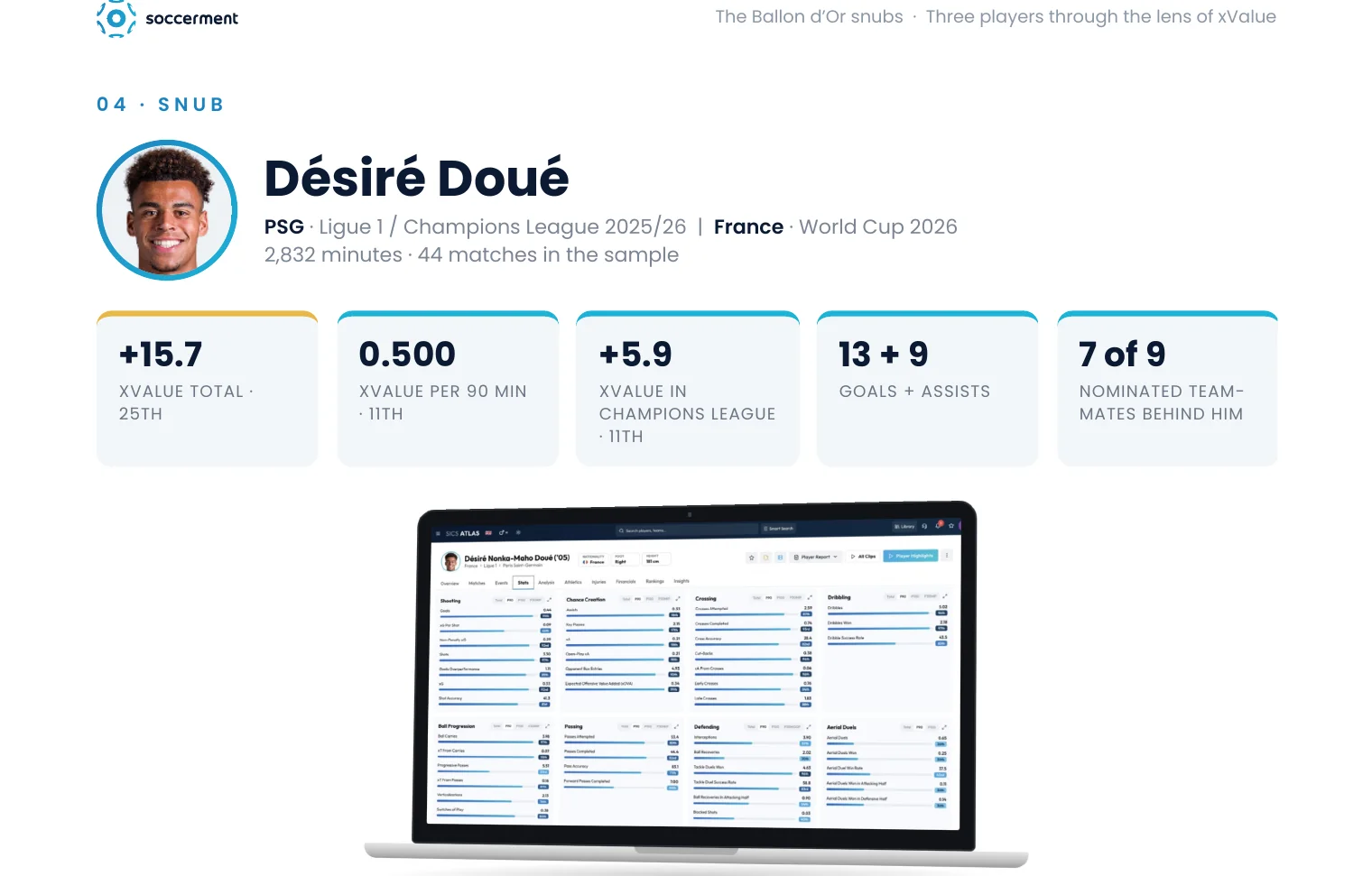
+15.7 xValue season total (25th in Europe), 0.500 per 90 minutes (11th), +5.9 in the Champions League (11th), 13 goals and 9 assists.
The case for: the best inside attacking midfielder in Europe, both by season total and per 90 minutes. He won the Champions League as a key player, worth +5.9 xValue in 934 minutes, while Dembélé, the holder, was worth +1.4 in the competition (124th of 167). He ranks ahead of 7 of his 9 nominated PSG team-mates.
The case against: two muscle injuries limited him to 23 of 34 Ligue 1 matches, and he started the World Cup semi-final lost to Spain on the bench.
Our read: the data raises no objection to his performance, only to his minutes and his place in PSG's pecking order.
Raphinha (Barcelona): the per-minute case
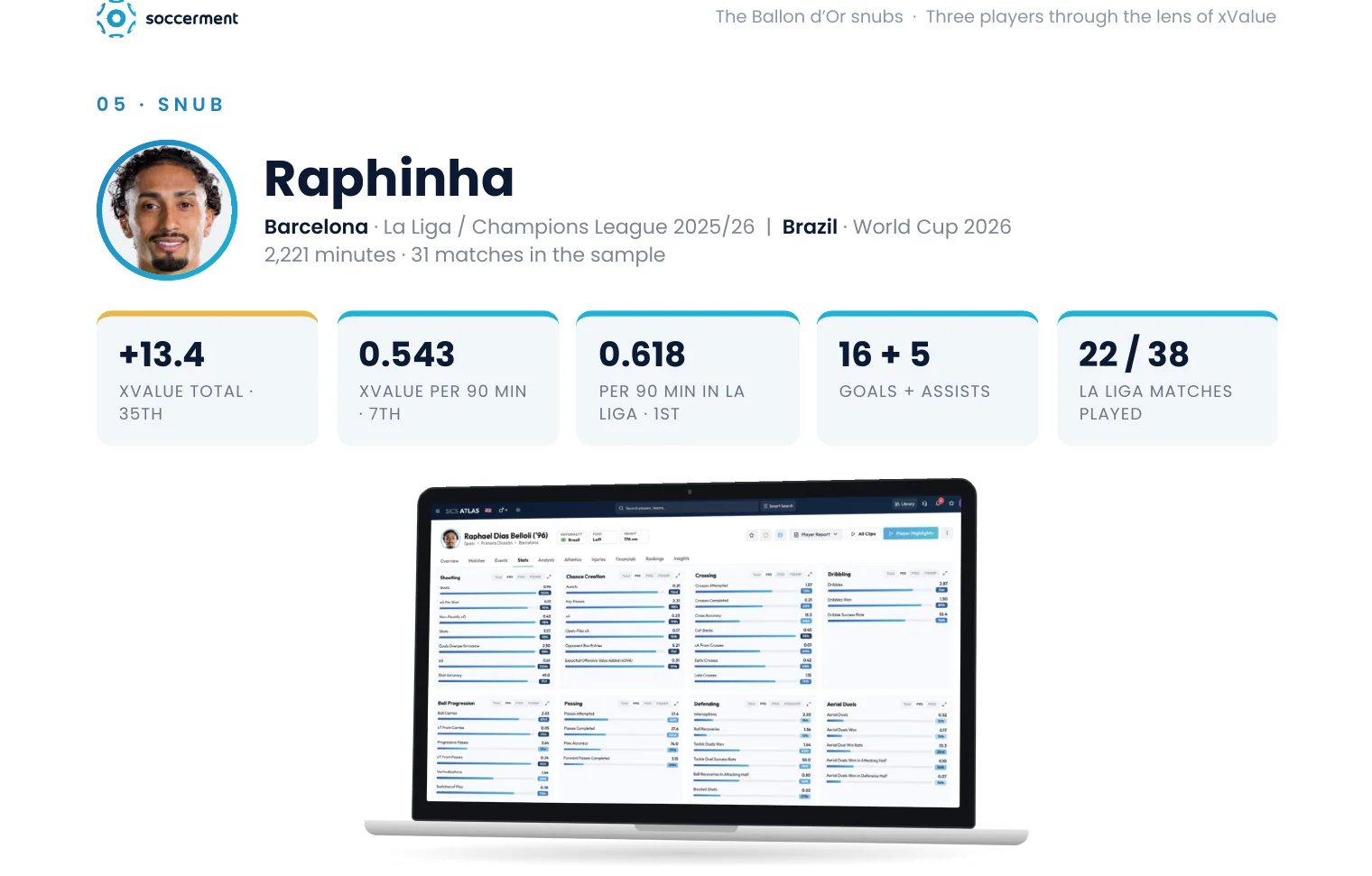
+13.4 xValue season total (35th in Europe), 0.543 per 90 minutes (7th in Europe), 0.618 per 90 minutes in La Liga (1st), 16 goals and 5 assists.
The case for: the best player in La Liga per 90 minutes, ahead of Lamine Yamal (0.602) and Vinícius (0.547). He also produced the best single match of the three: two goals and two assists against Newcastle in the Champions League round of 16, worth +2.65 xValue.
The case against: hamstring injuries cost him around 25 matches for club and country. He played 22 of 38 La Liga matches and only 144 minutes at the World Cup, and his season total is 35th, outside the top 30.
Our read: an exclusion explained by minutes, not by performance. Per 90 minutes nobody in La Liga was better, but he played half a season.
Enzo Fernández (Chelsea): the strongest numbers, the most awkward story
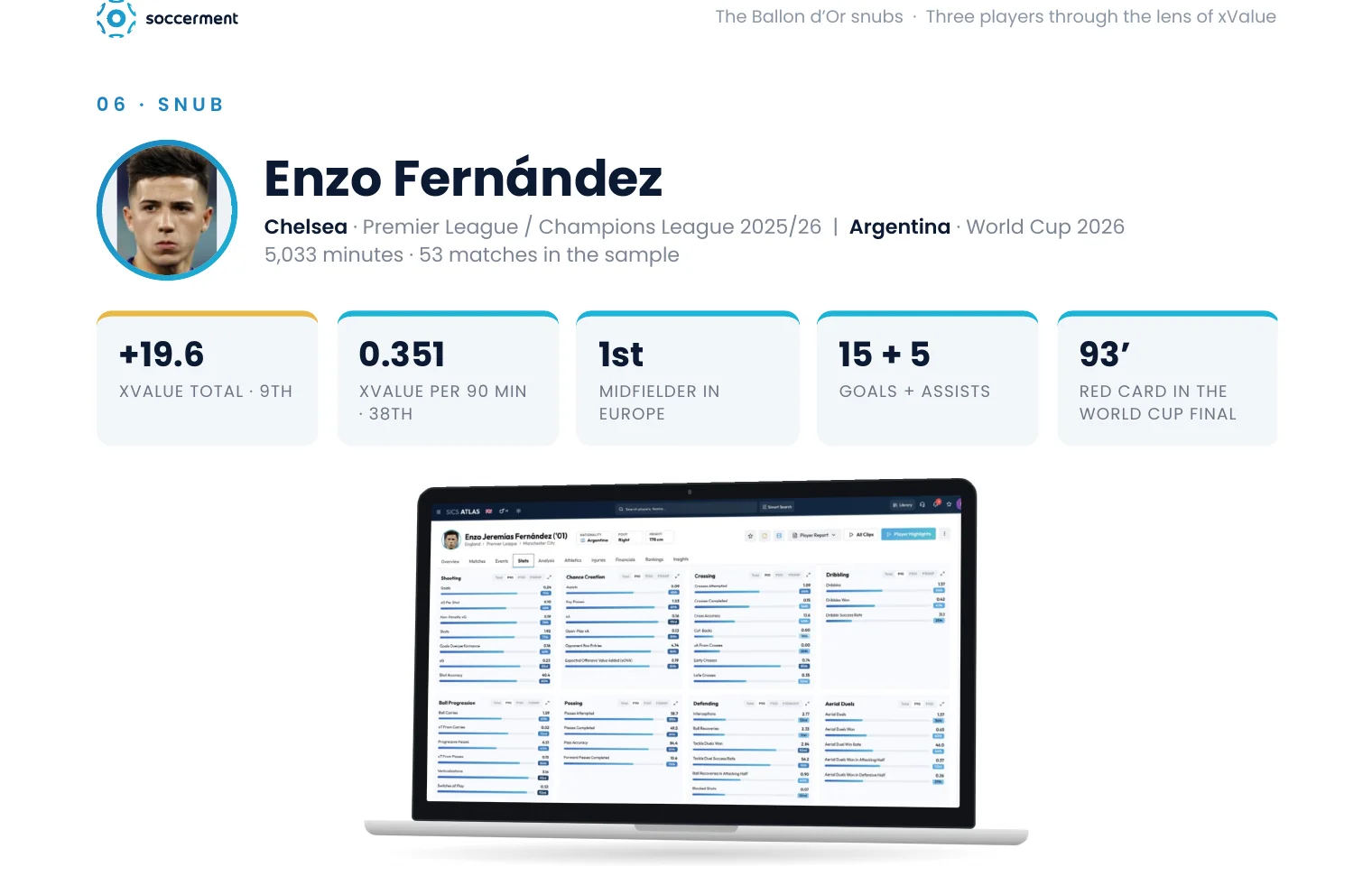
+19.6 xValue season total (9th in Europe), the best midfielder in Europe, 15 goals and 5 assists, and 5,033 minutes, the most in the top 10.
The case for: Europe's best midfielder by season total, ahead of Rice (+18.7), Vitinha (+17.6), Valverde (+17.5) and Bellingham (+17.0), and the only midfielder in Europe's top 10. He was always available and had 45 positive matches out of 53.
The case against: he was sent off in the World Cup final, and Argentina played extra time with ten men and lost 1-0. The award also weighs class and fair play, and xValue does not see cards. Per 90 minutes he is only 38th.
Our read: Europe's best midfielder on the pitch and, in everyone's memory, the man sent off in the final.
Our verdict: Doué is the hardest snub to explain
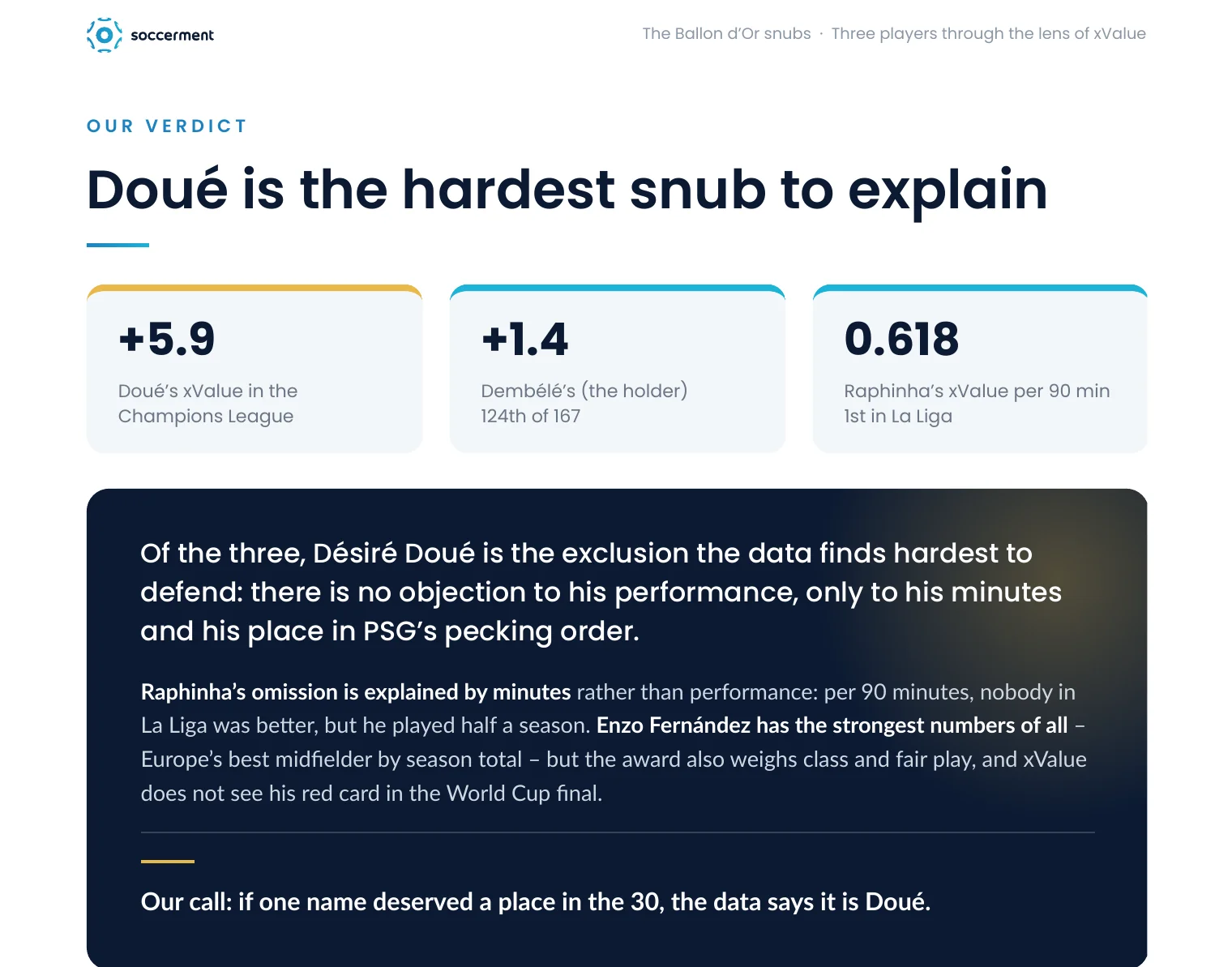
Of the three, Désiré Doué is the exclusion the data finds hardest to defend: there is no objection to his performance, only to his minutes and his place in PSG's pecking order. Raphinha's omission is explained by minutes, and Enzo Fernández has the strongest numbers, but the award also weighs class and fair play. Our call: if one name deserved a place in the 30, the data says it is Doué.
Key takeaways
- Désiré Doué is the snub the data finds hardest to explain: +5.9 xValue in the Champions League, against +1.4 for Dembélé, the holder.
- Raphinha was the best player in La Liga per 90 minutes (0.618 xValue) but played only 22 of 38 league matches.
- Enzo Fernández was Europe's best midfielder by season total xValue (+19.6) but was sent off in the World Cup final.
- The analysis covers 2,683 players across the top five leagues, the Champions League and the 2026 World Cup, using xValue and SICS Atlas data.
Read also: Harry Kane, Ballon d'Or 2026 winner: why the data says nobody finished better
FAQ
Who was the biggest Ballon d'Or 2026 snub according to the data?
According to Soccerment's xValue analysis, Désiré Doué. He was the best inside attacking midfielder in Europe and was worth +5.9 xValue in the Champions League won by PSG; the case against him is only his minutes.
What is xValue?
xValue is Soccerment's event-value metric. It measures how much every on-ball event changes a team's chances of scoring minus its chances of conceding in the next 30 seconds, in goals.
What does the data say about Raphinha's omission?
Per 90 minutes he was the best player in La Liga (0.618 xValue), but injuries limited him to 22 of 38 league matches: the data explains his omission with minutes, not performance.